You've been staring at the ceiling for forty minutes. The alarm goes off in six hours. Somewhere in the kitchen cabinet there's a bottle that promises to fix exactly this — and at 1 a.m., it looks very reasonable. Before you open it, it's worth knowing what a natural sleep supplement can actually do, and where the marketing gets ahead of the evidence.
The short version: some of these ingredients do something real, none do as much as the label implies, and the effect is usually measured in minutes, not hours. Here's what the research supports — and the one thing that outperforms all of it.
What Counts as a Natural Sleep Supplement — and What Sleep Doctors Say
A natural sleep supplement usually means one of two things: a hormone your body already makes (melatonin), or a plant or nutrient with a calming reputation — magnesium, valerian root, chamomile, lemon balm, passion flower, L-theanine, ashwagandha. Most products on the shelf combine several.
Here's the part the ads leave out. The American Academy of Sleep Medicine's 2017 clinical practice guideline on chronic insomnia in adults assessed melatonin, valerian, and L-tryptophan alongside prescription options, and issued a recommendation against all three for sleep onset or sleep maintenance insomnia.
That sounds damning until you read the fine print. Each was graded a weak recommendation, and the reason was the quality of the evidence, not evidence of harm — the trials were small, short, and inconsistent. Be precise about who that guideline is for, too: chronic insomnia disorder is a clinical diagnosis, not a rough week before a competition. If your sleep has been bad for months, that's a conversation with your healthcare provider, and the first-line treatment is behavioral therapy, not a capsule.

Melatonin Is a Timing Signal, Not a Sedative
Melatonin is the most-bought sleep ingredient in the country and the most misunderstood. It isn't a tranquilizer — it's the hormone your brain releases as light fades to signal that night has started. Taking it doesn't knock you out. It moves the clock.
The numbers are modest and remarkably consistent. A 2013 meta-analysis by Ferracioli-Oda and colleagues pooled 19 studies covering 1,683 people with primary sleep disorders. Melatonin beat placebo, but the margin was small: people fell asleep about 7 minutes faster (95% CI 4.37 to 9.75) and slept about 8 minutes longer (95% CI 1.75 to 14.75). Overall sleep quality improved too. Notably, the extra sleep time showed up on subjective measures — when researchers used objective sleep tracking, the total sleep gain didn't hold.
Seven minutes is a real effect. It is not the effect most people think they're buying. Melatonin earns its keep when your body clock is out of position — jet lag, a shift rotation, a schedule that's drifted late — and lower doses taken earlier in the evening tend to beat the 10 mg gummies stacked by the register.
There's a second problem, and it's a buying problem. A 2017 analysis in the Journal of Clinical Sleep Medicine tested 30 commercial melatonin products and found actual content ranging from 83% below to 478% above the label claim. Seventy-one percent missed their own label by more than 10%, lot-to-lot variation within a single product ran as high as 465%, and serotonin — a far more tightly controlled compound — turned up in 26% of samples. If you take melatonin, third-party testing isn't a nice-to-have. It's the whole ballgame.
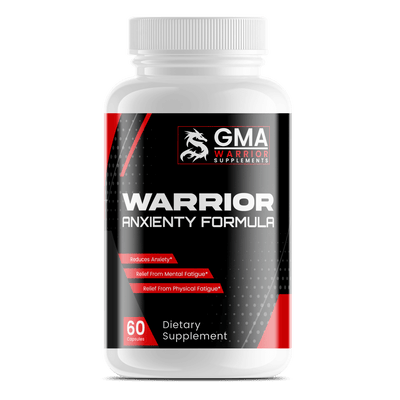
GMA Anxiety Formula — a relaxation blend built on the calming side of this list: ashwagandha, chamomile, lemon balm, passion flower, valerian root, magnolia, L-theanine, and magnesium, with the full ingredient deck printed on the label. Third-party tested, made in the USA in an FDA-registered facility.
Shop GMA Anxiety Formula →One honest caveat on any multi-ingredient formula, ours included: a blend is harder to evaluate than a single dosed ingredient. When eight botanicals share a capsule, you can't isolate which one is working, or match an ingredient to the dose used in a given trial. What you can demand is a label that tells you exactly what's in there — the minimum bar, and one a lot of sleep products don't clear. If you'd rather test one ingredient at a time, that's the more rigorous path, and we'd rather say so.
Magnesium, Valerian, and the Calming Botanicals
Magnesium is the ingredient most likely to help the most people, for an unglamorous reason: plenty of adults don't get enough from food, and it's genuinely involved in nerve signaling and the stress response. The sleep trials are small and the evidence quality is modest, but the mechanism is real and the safety profile at sensible doses is good. Form matters more than most labels admit — we broke that down in our guide to magnesium glycinate for sleep.
Valerian root is the classic herbal sleep aid and the one the sleep-medicine guideline explicitly declined to recommend. Trials going back decades report subjective improvement, but they disagree with each other, use different extracts at different strengths, and rarely survive strict methodological review. It may help you. The research can't yet tell you whether it will.
Chamomile, lemon balm, and passion flower all appear to act on GABA — the same neurotransmitter system prescription sleep medications target, at a far gentler level. Human trial data is thin; the traditional-use record is centuries long. Plausible mechanism, modest evidence, low risk.
L-theanine, the amino acid from green tea, is the odd one out — it promotes calm, unhurried alertness rather than drowsiness, which makes it better for taking the edge off a wired nervous system than for putting you under. We covered where it fits in our guide to nootropic supplements. And if your real problem is a brain that won't stop replaying the day, read what the research says about magnesium for anxiety and stress — for a lot of people, the sleep problem is a stress problem wearing a different hat.

Ashwagandha Has the Most Consistent Signal — and Real Cautions
If one ingredient here has earned a second look, it's ashwagandha. A 2021 systematic review and meta-analysis by Cheah and colleagues pooled five randomized controlled trials covering 400 participants and found a small but statistically significant improvement in overall sleep (standardized mean difference −0.59, 95% CI −0.75 to −0.42). The effect was strongest in adults actually diagnosed with insomnia, at doses of 600 mg per day or more, over eight weeks or longer. Participants also reported better mental alertness on waking and lower anxiety, with no serious side effects across those trials.
That's a bigger effect than melatonin's, and it showed up in how people felt the next morning — not just how fast they fell asleep. It also built over weeks, so judging it after three nights tells you nothing.
It isn't risk-free, and the honest version includes the cautions. The NIH Office of Dietary Supplements notes case reports of liver injury associated with ashwagandha, advises against use in pregnancy, and flags concerns for people with thyroid or hormone-sensitive conditions, plus potential interactions with diabetes, blood pressure, immunosuppressant, and sedative medications. If any of that describes you, or if you take prescription medication of any kind, talk to your healthcare provider before you start — not after.
The Part No Capsule Replaces
We've been coaching athletes at our martial arts school in Gallatin, TN for over 50 years, and the sleep conversation comes up constantly — usually from someone who spent 90 minutes rolling or hitting pads, drove home at 9 p.m. with their heart rate still up, then wondered why they couldn't shut down at 10. That's not a supplement problem. That's a nervous system that was told to fight two hours ago and never got the all-clear.
The levers that move sleep the most are free. A consistent wake time, seven days a week, does more than any bottle on this page. Bright light in the morning and dim light after sunset moves the same clock melatonin is trying to nudge. Caffeine's half-life of roughly five to six hours puts a 4 p.m. coffee squarely in your bedtime. And a real wind-down, even fifteen minutes of it, is the closest thing to a switch that exists.
Get those right and a supplement becomes what it should be: a small assist at the margins. Get them wrong and no capsule will save you. It's the same order of operations we teach for recovery generally, and why sleep outranks every product in our guide to supplements for muscle recovery — if you train hard, sleep is where the adaptation actually happens. Everything in our nootropics and mind-body collection is built to support that work, not substitute for it.

So what actually helps? Fix the schedule and the light first. If you're still struggling, magnesium is the lowest-risk place to start and ashwagandha has the best-supported signal — give it eight weeks. Use melatonin for what it's built for, a clock in the wrong position, not as a nightly sedative. Buy from someone who third-party tests. And if this has gone on for months, stop shopping and go see a professional.
Sources & Research
- Sateia, M.J., et al. "Clinical Practice Guideline for the Pharmacologic Treatment of Chronic Insomnia in Adults: An American Academy of Sleep Medicine Clinical Practice Guideline." Journal of Clinical Sleep Medicine, 2017;13(2):307–349. jcsm.aasm.org
- Ferracioli-Oda, E., Qawasmi, A., Bloch, M.H. "Meta-Analysis: Melatonin for the Treatment of Primary Sleep Disorders." PLoS ONE, 2013;8(5):e63773. journals.plos.org
- Erland, L.A.E., Saxena, P.K. "Melatonin Natural Health Products and Supplements: Presence of Serotonin and Significant Variability of Melatonin Content." Journal of Clinical Sleep Medicine, 2017;13(2):275–281. jcsm.aasm.org
- Cheah, K.L., Norhayati, M.N., Yaacob, L.H., Rahman, R.A. "Effect of Ashwagandha (Withania somnifera) extract on sleep: A systematic review and meta-analysis." PLoS ONE, 2021;16(9):e0257843. journals.plos.org
- National Institutes of Health, Office of Dietary Supplements. "Ashwagandha: Fact Sheet for Health Professionals." ods.od.nih.gov