Most people who take ashwagandha notice nothing worse than a sleepy afternoon or an unsettled stomach. A small number end up with jaundice, a racing heart, or a drug interaction nobody warned them about. Both groups exist, and what separates them is mostly predictable. This guide covers the common ashwagandha side effects, the rare serious ones, and the short list of people who should skip the herb entirely or clear it with a doctor first.
Common Ashwagandha Side Effects: Mild and Usually Short-Lived
The best safety data comes from trials in healthy adults. In a 2021 randomized, placebo-controlled study in Complementary Therapies in Medicine, 80 volunteers took 300 mg of ashwagandha root extract or a placebo twice a day for eight weeks. Researchers tracked blood counts, liver and kidney markers, and thyroid hormones. Nothing moved out of range, and no participant reported an adverse event.
A 2026 systematic review in Pharmaceuticals pooled 23 randomized trials covering 2,317 healthy adults on standardized root extracts at 125 to 600 mg a day for up to 180 days. Liver, kidney, blood, hormone and cardiovascular markers stayed within normal ranges. The complaints that did show up were stomach discomfort, headache and drowsiness, and they appeared in the placebo groups too. The National Center for Complementary and Integrative Health (NCCIH) gives the same list, adding diarrhea and vomiting in some people.
Two caveats come with the reassuring numbers. Most trials ran three months or less, and NCCIH says there isn't enough information to judge long-term safety. And the drowsiness is partly the point. It's why people take ashwagandha at night, and it's a reason not to take it before you drive or train hard.

The Rare One: Liver Injury
The serious side effect that gets the headlines is liver injury, and the case reports are real. A 2020 series in Liver International described five patients from Iceland and the US Drug-Induced Liver Injury Network. Two to twelve weeks after starting an ashwagandha product, each developed jaundice, nausea, itching and abdominal discomfort. None had liver failure, and liver tests returned to normal within one to five months in the four patients who were followed up. Four of the five were also taking other supplements.
A 2023 series from India in Hepatology Communications is the sobering one. It reported eight patients whose liver injury traced to single-ingredient ashwagandha products. Five already had chronic liver disease. Three of those developed acute-on-chronic liver failure, and all three died. Where the products could be tested, analysis found no contamination, only the herb's own compounds.
The takeaway is narrow. Liver injury is uncommon, and in healthy people it has usually resolved after stopping. But if you have any existing liver condition, ashwagandha is not worth the risk without your doctor's sign-off. Whoever you are, stop and get checked if you notice yellowing skin or eyes, dark urine or persistent itching.
Ashwagandha and Your Thyroid
Ashwagandha can raise thyroid hormone levels. In a 2018 randomized trial in the Journal of Alternative and Complementary Medicine, 600 mg a day for eight weeks raised T3 and T4 and lowered TSH in people with mildly underactive thyroids. That sounds like good news until you're already on thyroid medication, or your thyroid runs high. A 2022 case report in Cureus describes a 73-year-old woman who used ashwagandha for two years to self-manage an underactive thyroid. She developed thyrotoxicosis and a rapid heart rhythm, and both resolved after she stopped.
If you have any thyroid condition, take thyroid hormone, or get regular thyroid bloodwork, talk to your healthcare provider before you start, so the next lab result isn't a surprise.

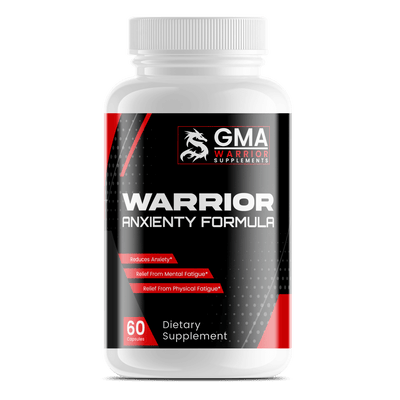
GMA Anxiety Formula is our evening wind-down blend. Straight talk: it isn't a standalone ashwagandha product. Ashwagandha is one of 18 herbs in an 830 mg proprietary blend per two-capsule serving, and the label doesn't print its amount. Blend ingredients are listed by weight, and ashwagandha comes third, so a serving holds no more than about 275 mg. The same blend includes St. John's wort, valerian, hops and 5-HTP. St. John's wort weakens many prescription drugs, and several of these herbs can add to the effect of sedatives. If you take any medication, or have a liver or thyroid condition, ask your pharmacist or doctor before you add it. Follow the label.
Shop GMA Anxiety Formula →Who Should Skip Ashwagandha
NCCIH's guidance is short and specific. Ashwagandha should be avoided during pregnancy and while breastfeeding. It isn't recommended for people with autoimmune or thyroid disorders, or for anyone with surgery coming up. Because it can raise testosterone, people with hormone-sensitive prostate cancer should avoid it. That hormone effect is measurable: in a 2019 crossover trial in the American Journal of Men's Health, men aged 40 to 70 saw testosterone rise 14.7% more on ashwagandha than on placebo.
Then there are the medications. NCCIH lists possible interactions with drugs for diabetes and high blood pressure, immunosuppressants, sedatives, anti-seizure medications and thyroid hormone. If anything on that list is in your cabinet, your pharmacist can check the combination in five minutes. That's a better plan than finding out on your own.
Add anyone under 18 and anyone managing a diagnosed medical condition. For all of these groups, the honest answer is a conversation with your healthcare provider, not a dose from a blog.

How to Lower Your Risk of Ashwagandha Side Effects
- Stay near the studied doses. The safety trials used 125 to 600 mg a day of root extract. A 2022 meta-analysis in Phytotherapy Research found the stress benefit at 300 to 600 mg a day, so more isn't better.
- Keep it short. NCCIH calls ashwagandha possibly safe for up to three months. Long-term data is thin, so a break after a few months is a reasonable default.
- Start one new supplement at a time. Four of the five liver cases in the 2020 series involved other supplements too. If something goes wrong, you want to know which product caused it.
- Count every source. Sleep blends, "adaptogen" stacks and testosterone formulas often hide ashwagandha in a blend. Read every label you take.
- Know the stop signs. Yellowing skin or eyes, dark urine, persistent itching, a racing or irregular heartbeat, or unusual fatigue. Stop and call your doctor.
In more than fifty years of running a martial arts school, we've heard plenty of questions about ashwagandha, usually from adults who come to class stressed and short on sleep. The evidence for stress relief is real. A 2024 meta-analysis in Explore found lower perceived stress and cortisol than placebo across nine trials. But it works best on top of the basics, not in place of them. Sleep, training and slow breathing come first, and practices like tai chi for stress relief carry none of these risks. For the wider picture, see our guide to natural supplements for anxiety, our review of natural sleep supplements, and our look at whether testosterone boosters work. Or browse the full Nootropics collection.
Sources & Research
- Verma N, Gupta SK, Tiwari S, Mishra AK. "Safety of Ashwagandha Root Extract: A Randomized, Placebo-Controlled, study in Healthy Volunteers." Complementary Therapies in Medicine, 2021;57:102642. PMID 33338583
- Coope OC, Willems MET, Levington A, et al. "Back to the Roots: Safety and Tolerability of Standardised Ashwagandha (Withania somnifera) Root Extract in Healthy Adults — A Systematic Review of Biomarkers and Adverse Events." Pharmaceuticals, 2026;19(5):725. PMID 42198398
- Björnsson HK, Björnsson ES, Avula B, et al. "Ashwagandha-induced liver injury: A case series from Iceland and the US Drug-Induced Liver Injury Network." Liver International, 2020;40(4):825–829. PMID 31991029
- Philips CA, Valsan A, Theruvath AH, et al. "Ashwagandha-induced liver injury — A case series from India and literature review." Hepatology Communications, 2023;7(10):e0270. PMID 37756041
- Sharma AK, Basu I, Singh S. "Efficacy and Safety of Ashwagandha Root Extract in Subclinical Hypothyroid Patients: A Double-Blind, Randomized Placebo-Controlled Trial." Journal of Alternative and Complementary Medicine, 2018;24(3):243–248. PMID 28829155
- Kamal HI, Patel K, Brdak A, et al. "Ashwagandha as a Unique Cause of Thyrotoxicosis Presenting With Supraventricular Tachycardia." Cureus, 2022;14(3):e23494. PMID 35475098
- Lopresti AL, Drummond PD, Smith SJ. "A Randomized, Double-Blind, Placebo-Controlled, Crossover Study Examining the Hormonal and Vitality Effects of Ashwagandha (Withania somnifera) in Aging, Overweight Males." American Journal of Men's Health, 2019;13(2):1557988319835985. PMID 30854916
- Akhgarjand C, Asoudeh F, Bagheri A, et al. "Does Ashwagandha supplementation have a beneficial effect on the management of anxiety and stress? A systematic review and meta-analysis of randomized controlled trials." Phytotherapy Research, 2022;36(11):4115–4124. PMID 36017529
- Arumugam V, Vijayakumar V, Balakrishnan A, et al. "Effects of Ashwagandha (Withania Somnifera) on stress and anxiety: A systematic review and meta-analysis." Explore, 2024;20(6):103062. PMID 39348746
- National Center for Complementary and Integrative Health. "Ashwagandha: Usefulness and Safety." nccih.nih.gov
- National Center for Complementary and Integrative Health. "St. John's Wort: Usefulness and Safety." nccih.nih.gov