An eye cream for dark circles can help, but only when it matches what is causing the darkness. Dermatologists sort under-eye circles into three main types: extra pigment in the skin, blood showing through thin skin, and shadows cast by the shape of the face. Most people have a mix. A cream can make a visible difference to the first two. It can't change the third. This guide covers how to tell which type you have, which ingredients have research behind them, and what to check on the label before you buy.
Why Dark Circles Happen
A 2014 study from Chang Gung Memorial Hospital in Taiwan examined 65 people with dark circles under a Wood's lamp and with ultrasound. It sorted them into four groups:
- Pigmented (brown). Extra melanin in the skin. Genetics plays a part, and so does skin irritation: rubbing, scratching and eczema around the eyes can all leave pigment behind.
- Vascular (blue to purple). The skin under the eye is some of the thinnest on the body, so blood in the vessels underneath shows through. Puffiness makes it look worse.
- Structural. Hollows (the tear trough), loose skin and fat pads that bulge under the lower lid cast a shadow. That shadow reads as a dark circle.
- Mixed. Two or more of the above.
Mixed was by far the most common type, at 78% of cases. Pure pigment was 5%, pure vascular 14% and pure structural 3%. So the right question is usually "how much of each?" rather than "which one?".
A 2016 review by dermatologists in New Delhi describes a simple check you can do in a mirror. Gently stretch the skin under your eye with a fingertip. True pigment stays the same color when stretched. A shadow from the tear trough fades or disappears. If the area turns more purple as you stretch, the skin is thin and the vessels underneath are showing.

What an Eye Cream for Dark Circles Can Do
The research here is thin. A 2021 systematic review in Dermatologic Surgery found 39 studies on ways to reduce dark circles, and its authors warned about the "scarcity of high-quality evidence." Most topical trials are small, short or unblinded. With that caveat, here is what has been tested, matched to type.
For pigment: niacinamide and vitamin C. Niacinamide (vitamin B3) slows the transfer of pigment from the cells that make it to the surrounding skin cells. In a Procter & Gamble study published in the British Journal of Dermatology, 18 people with facial dark spots used a 5% niacinamide moisturizer on one side and a plain moisturizer on the other. Pigmentation faded more on the niacinamide side after four weeks. That study was on the face, not specifically under the eyes, but the mechanism is the same. Our guide to niacinamide serum covers how to use it. Stronger lighteners such as hydroquinone and prescription retinoic acid are options a dermatologist can discuss with you. They are not for self-experimenting on eyelid skin.
For thin skin and visible vessels: vitamin K, retinol and vitamin C. In a 2004 Japanese study, 57 adults applied a gel with 2% vitamin K (phytonadione), 0.1% retinol and 0.1% vitamins C and E twice a day for eight weeks. 47% had less visible blood pooling and some had fewer fine lines. Pigment didn't change, and there was no placebo group. A six-month split-face trial from the Japanese company POLA tested 10% sodium ascorbate (a form of vitamin C) in 14 people. Redness under the eye worsened less on the treated side, and the skin there tended to get thicker, which may help hide the vessels beneath. The thickness change didn't reach statistical significance. Retinol builds collagen over time too, and our guide to using retinol without irritation explains how to start slowly.
For puffiness: caffeine. Caffeine narrows blood vessels and shows up in almost every morning eye product. The human data is modest. One trial of a pad with 3% caffeine and 1% vitamin K reported less darkness and fewer wrinkles after four weeks, but it enrolled only 11 women, and the comparison side got a pad soaked in water.
For hollows and shadows: nothing in a jar. The 2021 review found that fillers and fat grafting worked best for dark circles caused by volume loss, and eyelid surgery worked best for loose skin. Moisturizing ingredients can make crepey skin reflect light a little better. They can't fill a tear trough.
How to Read an Eye Cream Label
Once you know your type, the label tells you whether a product has a chance. Look for the active ingredients by name, and compare them with the strengths used in the studies above:
- Niacinamide around 5% for brown, pigment-based circles
- Vitamin K (phytonadione) around 1–2%, usually paired with retinol or caffeine, for bluish circles
- Vitamin C (sodium ascorbate or ascorbic acid) for thin, bluish skin
- Caffeine around 3% for morning puffiness
- Retinol at a low strength, introduced slowly, for long-term skin thickness
Most labels won't print percentages, so position is your best clue. An active listed after the preservatives is probably present in a small amount. Opaque or pump packaging protects vitamin C and retinol, which break down in light and air. And "brightening" on the front of a jar is a marketing word. If none of the ingredients above are on the back, the product is a moisturizer. That still has a job, but it won't change pigment or vessels. For the anti-aging side of the eye area (crow's feet and fine lines), see our separate guide to anti-wrinkle eye cream.
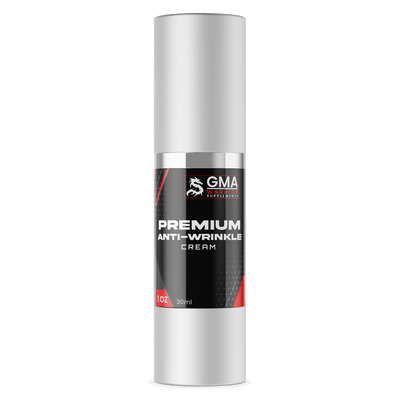
GMA Warrior Premium Anti-Wrinkle Cream. To be straight with you: this is a face cream, not an eye cream, and its label contains none of the dark-circle actives above. No vitamin K, caffeine, niacinamide, vitamin C or retinol. What it does carry is glycerin, squalane, sweet almond oil, CoQ10 (ubiquinone) and three peptides, so it works as the face moisturizer alongside a targeted eye product. The product page advises avoiding direct contact with the eyes, so keep it to your face rather than the lid.
Shop Premium Anti-Wrinkle Cream →
Habits That Matter as Much as the Cream
Sleep. In a 2013 Karolinska Institute study published in Sleep, ten people were photographed after a normal night and again after 31 hours awake. Forty observers rated the sleep-deprived faces as having darker circles, more swollen eyes and paler skin. The 2016 review notes that the links between dark circles and sleep, stress, alcohol and smoking haven't been proven in clinical trials. Still, sleep is free and helps everything else, and our guide to natural sleep supplements covers the basics.
Stop rubbing. Rubbing and scratching the eye area can leave pigment behind. If itchy eyes keep you rubbing, talk to your doctor about the cause rather than reaching for a stronger cream.
Block the sun. UV light makes under-eye pigment worse. Use a broad-spectrum sunscreen made for the eye area and wear UV-blocking sunglasses outdoors.
Be patient. The trials above ran from four weeks to six months. Give any eye cream for dark circles at least eight weeks of twice-daily use before you judge it. After more than fifty years of teaching martial arts, we see the same pattern on the mat: people quit a sound program before it has had time to work.

When to See a Dermatologist
Over-the-counter creams are a reasonable first step for mild, long-standing circles. Book a visit instead if the darkness appeared suddenly, affects only one eye, comes with swelling, itching or a rash, or if the stretch test shows the problem is mainly hollows or loose skin. A dermatologist can confirm your type and discuss options a cream can't reach, from prescription lighteners and chemical peels to fillers. If you are pregnant or nursing, check with your doctor before using retinol or other strong actives. Concealer is a perfectly good tool in the meantime, and a 2016 review of under-eye care lists it as the least invasive option.
For a full routine around these steps, start with our premium skin care collection and our guide to vitamin C serum.
Sources & Research
- Huang YL, Chang SL, Ma L, Lee MC, Hu S. "Clinical analysis and classification of dark eye circle." International Journal of Dermatology, 2014;53(2):164–170. PMID 23879616
- Sarkar R, Ranjan R, Garg S, et al. "Periorbital Hyperpigmentation: A Comprehensive Review." Journal of Clinical and Aesthetic Dermatology, 2016;9(1):49–55. PMID 26962392
- Michelle L, Pouldar Foulad D, Ekelem C, Saedi N, Mesinkovska NA. "Treatments of Periorbital Hyperpigmentation: A Systematic Review." Dermatologic Surgery, 2021;47(1):70–74. PMID 32740208
- Hakozaki T, Minwalla L, Zhuang J, et al. "The effect of niacinamide on reducing cutaneous pigmentation and suppression of melanosome transfer." British Journal of Dermatology, 2002;147(1):20–31. PMID 12100180
- Mitsuishi T, Shimoda T, Mitsui Y, Kuriyama Y, Kawana S. "The effects of topical application of phytonadione, retinol and vitamins C and E on infraorbital dark circles and wrinkles of the lower eyelids." Journal of Cosmetic Dermatology, 2004;3(2):73–75. PMID 17147559
- Ohshima H, Mizukoshi K, Oyobikawa M, et al. "Effects of vitamin C on dark circles of the lower eyelids: quantitative evaluation using image analysis and echogram." Skin Research and Technology, 2009;15(2):214–217. PMID 19626722
- Ahmadraji F, Shatalebi MA. "Evaluation of the clinical efficacy and safety of an eye counter pad containing caffeine and vitamin K in emulsified Emu oil base." Advanced Biomedical Research, 2015;4:10. PMID 25625116
- Sundelin T, Lekander M, Kecklund G, et al. "Cues of fatigue: effects of sleep deprivation on facial appearance." Sleep, 2013;36(9):1355–1360. PMID 23997369
- Vrcek I, Ozgur O, Nakra T. "Infraorbital Dark Circles: A Review of the Pathogenesis, Evaluation and Treatment." Journal of Cutaneous and Aesthetic Surgery, 2016;9(2):65–72. PMID 27398005