Here is the uncomfortable truth about supplements for athletes over 40: almost nobody has tested them on you. The trials recruit either twenty-two-year-old students or sixty-five-year-olds starting their first strength program. The forty-five-year-old who still spars twice a week sits in the gap between those two groups, and the research has mostly left that gap empty.
What the research does show is how the body changes on either side of it. Once you know what shifts, and roughly when, the short list of what's worth taking gets clear. It's three items, and one of them is food.
What Changes After 40 — and What Doesn't
The clearest measurement comes from Australia. Researchers compared trained triathletes averaging 53 years old with trained triathletes averaging 27, put both groups through a muscle-damaging downhill run, and then three days of hard cycling. The older athletes built new muscle protein about 12 percent more slowly over those three days, and their performance the morning after tended to bounce back less. That was five older athletes against six younger ones, so it's a signal, not a verdict.
A review of masters-athlete research by part of the same group is the necessary counterweight. It found the age effect on recovery may be smaller than long assumed, and that inactivity explains more of the decline people blame on birthdays. That matches what we see on the mats. In fifty years of teaching at our martial arts school, the students who keep training into their fifties aren't the ones with the best supplement stack. They're the ones who never stopped showing up.
So the goal after 40 isn't to beat the calendar with a capsule. It's to close the two gaps research can actually measure: muscle that responds less to a normal meal, and strength that drifts down unless you give it a reason not to.

Protein: The Supplement for Athletes Over 40 That Is Really a Meal Plan
A McMaster analysis measured how much protein it takes, in a single meal, to max out muscle building. Men around 22 hit the ceiling at about 0.24 grams per kilogram of body weight. Men around 71 needed about 0.40, roughly two-thirds more. For an 80 kg (176 lb) athlete, that's the difference between 19 grams and 32 grams at a sitting. The older men didn't build less muscle overall. They just needed a bigger dose to get there.
The PROT-AGE study group turned that into a daily target for people over 65: at least 1.0–1.2 g/kg a day, and 1.2 g/kg or more for anyone who exercises. A meta-analysis of 49 training studies set the useful upper limit at about 1.6 g/kg; beyond that, extra protein built no more muscle. The same paper found the benefit of added protein shrank a little with every year of age. That argues for eating enough, spread across meals, rather than a bigger shake. Our guide to how much protein you need works through the math by body weight.
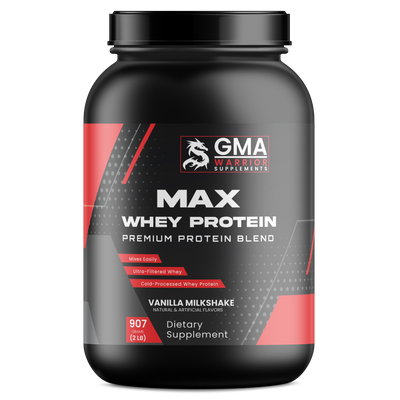
If whole food falls short, a scoop fills the gap. The label on our Max Whey Protein Vanilla Milkshake prints 24 grams of protein per 30.3-gram scoop, a whey isolate and concentrate blend. It's a convenient 24 grams, not a magic one. One caution from PROT-AGE: people with significantly reduced kidney function may need to limit protein, so talk to your healthcare provider first if that's you.
Creatine: The Best-Tested Option for Older Muscle
Creatine has the deepest evidence base in older lifters of anything on the shelf. A 2017 meta-analysis pooled 22 randomized trials and 721 men and women, with average ages of 57 to 70, who lifted two or three days a week for 7 to 52 weeks. Compared with placebo, creatine added 1.37 kg of lean tissue and produced larger strength gains on both chest press and leg press. An earlier McMaster meta-analysis found the same pattern plus a better 30-second chair-stand score. That's the one test in this list that looks like getting up off the mat.
Two catches. Every one of those trials paired creatine with resistance training, so the effect is creatine plus the work, never instead of it. And the lifters were older than you, which means the benefit for a 45-year-old is an inference from the same biology, not a measurement. The International Society of Sports Nutrition puts the maintenance dose at 3–5 grams a day and found it well tolerated in healthy adults. Anyone with kidney disease should clear it with their healthcare provider first. Loading is optional — our breakdown of the creatine loading phase explains why.
GMA Warrior Creatine Powder — the supplement facts panel lists one ingredient, creatine monohydrate, at 5,000 mg per 5-gram scoop: the top of the ISSN maintenance range, nothing else in the tub. One honest note: the product description says 100 servings, but the label photo prints 60. Plan around the label.
Shop Warrior Creatine Powder →
Fish Oil: A Real Result at a Real Dose
Omega-3s are usually sold on heart and joint claims. The most interesting finding for aging athletes is about muscle. In a Washington University trial, 60 healthy adults aged 60 to 85 took either prescription fish oil or corn oil for six months. The fish-oil group finished with 3.6 percent more thigh muscle volume, 2.3 kg more grip strength and 4 percent more one-rep-max strength than the controls.
The dose is the part most people skip. Those capsules delivered 1.86 g of EPA and 1.50 g of DHA a day, 3.36 grams in total. Our Max Omega 3 label prints 720 mg of EPA plus DHA per softgel, so matching the trial would take about five a day, more than the two to three on the bottle. The trial used a prescription product, and it's one study. Fish oil at that level can also interact with blood thinners, so check with your provider if you take one. Our omega 3 benefits for athletes guide covers food sources too.

How We'd Build Supplements for Athletes Over 40
In order of evidence: first, enough protein, eaten as three or four real servings a day, with a scoop only where meals fall short. Second, 3–5 grams of creatine every day, paired with lifting at least twice a week, because every trial that worked included the lifting. Third, fish oil if you'll actually take a dose near the one that was tested; a couple of softgels is a different product from the study.
For joints, collagen has better athlete data than the glucosamine aisle. See our guide to supplements for joint health. For the broader recovery picture, sleep still outranks everything above, as our fighter's guide to muscle recovery argues. Browse the full premium sports nutrition line when you've decided what you need. Then give it twelve weeks and keep showing up. At our academy, that part has never come in a tub.
Sources & Research
- Doering TM, et al. "Lower Integrated Muscle Protein Synthesis in Masters Compared with Younger Athletes." Medicine & Science in Sports & Exercise, 2016;48(8):1613–1618. PubMed
- Borges N, et al. "Age-Related Changes in Performance and Recovery Kinetics in Masters Athletes: A Narrative Review." Journal of Aging and Physical Activity, 2016;24(1):149–157. PubMed
- Moore DR, et al. "Protein ingestion to stimulate myofibrillar protein synthesis requires greater relative protein intakes in healthy older versus younger men." Journals of Gerontology Series A, 2015;70(1):57–62. PubMed
- Bauer J, et al. "Evidence-based recommendations for optimal dietary protein intake in older people: a position paper from the PROT-AGE Study Group." Journal of the American Medical Directors Association, 2013;14(8):542–559. PubMed
- Morton RW, et al. "A systematic review, meta-analysis and meta-regression of the effect of protein supplementation on resistance training-induced gains in muscle mass and strength in healthy adults." British Journal of Sports Medicine, 2018;52(6):376–384. PMC
- Chilibeck PD, et al. "Effect of creatine supplementation during resistance training on lean tissue mass and muscular strength in older adults: a meta-analysis." Open Access Journal of Sports Medicine, 2017;8:213–226. PMC
- Devries MC, Phillips SM. "Creatine supplementation during resistance training in older adults — a meta-analysis." Medicine & Science in Sports & Exercise, 2014;46(6):1194–1203. PubMed
- Kreider RB, et al. "International Society of Sports Nutrition position stand: safety and efficacy of creatine supplementation in exercise, sport, and medicine." Journal of the International Society of Sports Nutrition, 2017;14:18. PMC
- Smith GI, et al. "Fish oil-derived n-3 PUFA therapy increases muscle mass and function in healthy older adults." American Journal of Clinical Nutrition, 2015;102(1):115–122. PMC