If you've ever stood in front of a fridge after training and wondered how much protein do I need, you're asking the right question at the right time. The 2025–2030 Dietary Guidelines for Americans just raised the recommended intake from the decades-old 0.8 g/kg to 1.2–1.6 g/kg per day — a shift that finally aligns official guidance with what sports nutrition researchers have been saying for years. For a 170-pound person, that's roughly 93–123 grams daily, and athletes who train hard typically need even more.
This guide breaks down the current research on daily protein requirements — by body weight, activity level, age, and training goal — so you can dial in the number that actually matches your life, not just a textbook minimum.
Why the Old Protein Recommendation Was Too Low
For decades, the U.S. Recommended Dietary Allowance sat at 0.8 grams of protein per kilogram of body weight per day. That number was originally set to prevent deficiency in sedentary adults — the bare minimum to keep nitrogen balance positive, not the amount needed to build or maintain muscle under any real-world training load. As the Examine.com protein research team points out, a more appropriate statistical analysis of the original nitrogen-balance data suggests the true minimum is closer to 1.0 g/kg, and optimal intake sits well above that range.
The updated 2025–2030 Dietary Guidelines acknowledged this gap and raised the target to 1.2–1.6 g/kg — a meaningful jump that reflects decades of accumulated evidence. If you've been loosely following the "50–60 grams a day" advice, you're almost certainly undereating protein relative to your actual needs, especially if you train regularly.

How Much Protein Do You Need by Activity Level
Your daily protein target depends on three variables: body weight, how often and intensely you train, and your primary goal. Here's what the International Society of Sports Nutrition's position stand on protein and exercise recommends, based on a review of the controlled research:
Sedentary or lightly active: 1.2–1.4 g/kg per day. This is the updated baseline for general health — enough to support normal tissue turnover, immune function, and gradual age-related muscle preservation. For a 150-pound (68 kg) person, that's about 82–95 grams daily.
Regular exercisers and recreational athletes: 1.4–1.6 g/kg per day. If you're hitting the gym 3–4 times a week, taking group classes, or training martial arts a few nights a week, this range supports recovery and gradual strength gains without overcomplicating your diet.
Serious strength and power athletes: 1.6–2.0 g/kg per day. Competitive lifters, combat sport athletes, and anyone prioritizing hypertrophy need the upper range. The ISSN's 2017 position stand confirmed that 1.4–2.0 g/kg covers the needs of "most exercising individuals," with strength athletes consistently gravitating toward 1.6–1.8 g/kg in practice.
Athletes in a calorie deficit (cutting weight): 2.3–3.1 g/kg per day. When you're restricting calories — for a weight class, a fight camp, or a body recomposition phase — protein needs spike significantly. Higher intake during a deficit protects lean mass that would otherwise be lost alongside fat. This is the most commonly underdosed scenario in combat sport athletes.
Protein Needs Change as You Age
Starting around age 40, your body becomes less efficient at using dietary protein to build and repair muscle — a phenomenon researchers call anabolic resistance. The practical result: the same 25-gram protein serving that triggered robust muscle protein synthesis in your twenties produces a blunted response two decades later.
To counter this, current research recommends adults over 40 aim for at least 1.0–1.2 g/kg per day as a minimum floor, with physically active older adults pushing closer to 1.6 g/kg. At Global Martial Arts USA, we've coached students well into their 60s and 70s — and the ones who maintain their strength on the mats are almost always the ones who prioritize protein at every meal, not just dinner.
The ISSN's research review also highlights that per-meal protein doses of 0.4–0.55 g/kg (roughly 30–40 grams per sitting for most adults) are more effective for older populations than the 20-gram servings often cited in general nutrition advice.

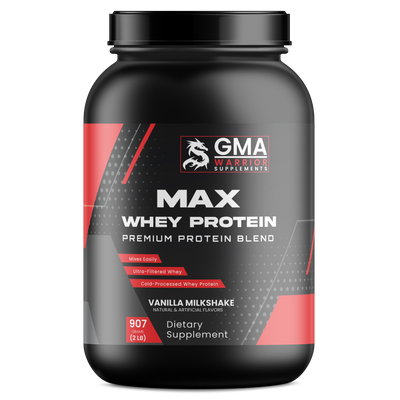
GMA Warrior Max Whey Protein Vanilla Milkshake — 25 grams of fast-absorbing whey per serving, designed for post-training recovery. Made in USA, lab tested, no proprietary blends.
Shop GMA Whey Protein →Timing and Distribution: How to Spread Your Protein
Total daily intake matters more than timing — that much the research is clear on. But distribution across meals does make a measurable difference, particularly for athletes training more than once per day or people over 40 dealing with anabolic resistance.
The current evidence points to 20–40 grams of high-quality protein per meal, spread across 3–4 eating occasions throughout the day. Front-loading all your protein at dinner — a common pattern — leaves your body in a prolonged post-absorptive state for most of the day, which limits the number of muscle protein synthesis "spikes" you get in a 24-hour cycle.
Post-training protein is the one timing window with consistent evidence behind it. Consuming 20–40 grams within roughly two hours after resistance training supports the recovery cascade more effectively than delaying until the next meal. If you've been following our guide on the best time to take creatine, you already know the post-workout window is prime territory for stacking both nutrients.
Best Protein Sources for Athletes and Active Adults
Not all protein sources are equal when it comes to muscle protein synthesis. The key differentiator is leucine content — the amino acid that acts as the primary trigger for the mTOR signaling pathway that initiates muscle repair. Whey protein is the most leucine-dense common source, which is why it remains the go-to for post-training shakes across combat sports, strength training, and endurance disciplines.
Beyond whey, prioritize complete protein sources that deliver all nine essential amino acids in meaningful amounts: eggs, poultry, fish, lean beef, Greek yogurt, and cottage cheese. Plant-based athletes can hit their targets by combining complementary sources — rice and pea protein blends, for example, produce an amino acid profile that rivals whey in clinical comparisons.
The practical move: anchor each meal around 25–40 grams from a complete source, then fill gaps with a quality sports nutrition supplement if whole foods alone don't get you to your daily target. Most athletes we work with find that one or two protein shakes per day — one post-training, one between meals — closes the gap without requiring a dramatic overhaul of their cooking habits.

Signs You're Not Getting Enough Protein
Chronic under-eating of protein doesn't always announce itself with dramatic symptoms. The early signals are subtle enough to dismiss as "just getting older" or "overtraining" — which is exactly why they go unaddressed for months. Watch for these patterns:
Slow recovery between sessions. If you're still sore 72 hours after a training session that used to fade in 48, inadequate protein is one of the first variables to check. Muscle protein synthesis requires amino acid availability — without sufficient raw material, the repair timeline stretches.
Strength plateaus despite consistent training. Progressive overload works only when the body has the substrate to adapt. Stagnating lifts or mat performance with no obvious programming issue often traces back to nutrition, and protein is usually the limiting factor.
Increased hunger and cravings. Protein is the most satiating macronutrient. If you find yourself constantly snacking or craving carbs between meals, a low protein intake may be driving the cycle. Bumping each meal to 30+ grams often resolves the pattern within a week.
Frequent illness or slow-healing injuries. Your immune system runs on amino acids. Glutamine, arginine, and the branched-chain amino acids all play direct roles in immune cell proliferation and wound repair. Chronically low protein intake can compromise both. If you're getting sick more than twice a year or minor training injuries linger, consult your healthcare provider — and consider auditing your protein intake as part of the conversation.
Sources & Research
- Jäger, R., et al. "International Society of Sports Nutrition Position Stand: Protein and Exercise." Journal of the International Society of Sports Nutrition, 2017. PMC5477153
- U.S. Department of Agriculture & Department of Health and Human Services. "2025–2030 Dietary Guidelines for Americans." January 2026. dietaryguidelines.gov
- Examine.com. "Optimal Protein Intake Guide." examine.com
- Martínez-Arnau, F.M., et al. "Athletes' Nutritional Demands: A Narrative Review of Nutritional Requirements." Nutrients, 2024. PMC10848936