L-theanine focus claims usually come with a promise: calm, clear attention without the jitters of caffeine. The research behind that promise is real, but it is smaller and more specific than the label copy suggests. A single dose has sharpened simple attention in several controlled trials. Complex attention is less convincing. And in the longest trial we found, twelve weeks of daily use did not improve attention at all.
Here is what the trials measured, the dose they used, how to take it, and an honest read on the one GMA formula whose label lists it.
What L-Theanine Is and What It Does in the Brain
L-theanine is an amino acid found almost only in tea leaves. A cup of green tea contains roughly 25 mg. Supplements usually carry 100 to 200 mg, the equivalent of four to eight cups.
The best-known effect shows up on an EEG. In a small study from Unilever's research institute, 50 mg of L-theanine raised alpha-wave activity in resting adults more than placebo did over the following 45 to 105 minutes. Alpha activity is associated with a relaxed but awake state, which is where the "calm focus" reputation comes from. That study measured brain waves, not performance, so on its own it tells you the compound does something, not that it makes you better at a task.
If you want the broader picture of which focus supplements hold up, our fighter's guide to nootropic supplements ranks them against each other.

What the L-Theanine Focus Trials Actually Measured
Three controlled trials tested L-theanine by itself. Together they show a narrow effect: some help on fast, simple tasks at best, and not much on hard ones.
Kahathuduwa, 2017. Twenty healthy men each took all five conditions on separate days: 200 mg of L-theanine, 160 mg of caffeine, both together, one cup of black tea, or water. L-theanine alone improved reaction time on a visual recognition task by about as much as caffeine did. The single cup of tea did nothing measurable, which fits the dose gap.
Dassanayake, 2023. The same group ran a dose-response trial in 32 young adults: 100, 200 and 400 mg against placebo. Once the placebo effect was subtracted, the only significant gain was on simple reaction time, about 16 milliseconds faster at both 100 and 200 mg. Sustained attention and impulse control did not improve. The authors concluded L-theanine helps simple visuomotor attention but not complex attention.
Haskell, 2008. A British crossover trial gave 250 mg of L-theanine alone and found no benefit on its own. Participants rated more headache and did worse on one arithmetic task. The combination with caffeine, however, improved several measures.
Put together: L-theanine alone is a modest tool. It is not the "limitless" pill it gets sold as.
One Dose Versus Twelve Weeks
This is the part most product pages skip. In a 2021 randomized trial funded by a Japanese tea company, about 50 adults aged 50 to 69 took 100 mg of L-theanine or placebo every day for twelve weeks. After the first single dose, the L-theanine group reacted faster on an attention task and made fewer errors on a working-memory task. After twelve weeks of daily use, the attention benefit was gone. The authors said so plainly.
A 2019 trial ran four weeks at 200 mg a day in 30 healthy adults, in a crossover design. It reported better verbal fluency and executive-function scores, along with lower stress and better sleep-quality scores. The tablets were supplied by an L-theanine manufacturer, and two of its employees were co-authors. That doesn't make the results wrong, but it is one small trial, and it has not been independently repeated.
The practical takeaway: L-theanine behaves more like a tool you use for a specific session than a daily supplement that builds up.
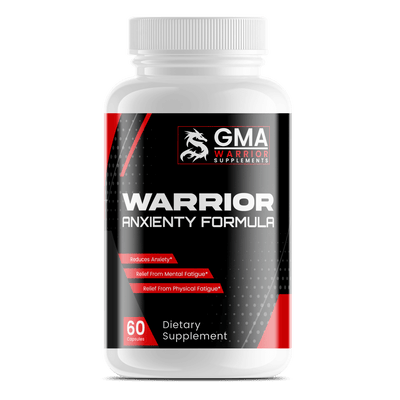
GMA Anxiety Formula. It is the one GMA product whose label lists L-theanine, as one of 18 ingredients in an 830 mg proprietary blend. The label does not print the L-theanine amount, so we can't tell you it matches the 100–200 mg used in the trials. It is built as a calming, wind-down formula, not a daytime focus product. Read the label notes below before you buy.
Shop GMA Anxiety Formula →Where It Fits: Calm Focus Under Pressure
The stronger case for L-theanine may be staying steady under stress rather than raw speed. In a small Japanese study, 12 people took L-theanine or placebo before a stressful mental arithmetic task. With L-theanine, their heart rate rose less. A 2020 systematic review of nine randomized trials concluded that 200 to 400 mg a day may help people under stressful conditions. It also said larger, longer studies are needed before anyone calls it a treatment.
That matches something every martial artist knows. The fighter who loses focus in the first round usually isn't tired. They're over-amped. Fifty years of teaching at our school has shown us that the skill of staying loose under pressure is trained on the mat, through breathing and repetition. That's also why many of our students pair hard training with tai chi for stress relief. A supplement can take the edge off; it can't replace that practice.
Most of the attention research actually pairs L-theanine with caffeine. A 2014 meta-analysis of 11 trials found moderate benefits from the pair for alertness and task switching in the first two hours, with the caffeine dose appearing to matter more than the L-theanine dose. We cover the trial doses and timing in our nootropic stack for energy guide.

How to Use It, and an Honest Read on Our Label
- Dose: for L-theanine focus, the attention trials used 100 to 200 mg. Going to 400 mg added nothing in the dose-response trial.
- Timing: about 45 to 60 minutes before the task. That's when the trials tested.
- Use it for sessions, not as a daily habit. The twelve-week trial found the attention effect didn't last with daily use.
- Safety: it was well tolerated in these short trials. If you are pregnant or nursing, under 18, or take prescription medication, talk to your healthcare provider first.
Our Anxiety Formula is the one product in our nootropics collection whose label lists L-theanine. When we read the supplement-facts panel for this article, three things stood out. First, the L-theanine sits inside a proprietary blend, so the amount per serving isn't printed. Second, the same blend includes valerian, hops, passion flower and 5-HTP, which is why we position it as a wind-down formula, not something to take before a morning of focused work. Third, it contains St. John's wort, which interacts with many common medications, including birth control and antidepressants. If you take any prescription drug, check with your pharmacist before using it. Our guide to magnesium for anxiety covers the other calming ingredients in the same family.
If what you want is the dose from the trials, a standalone L-theanine capsule with the milligrams printed on the label is the honest answer. GMA doesn't make one.

Sources & Research
- Nobre AC, Rao A, Owen GN. "L-theanine, a natural constituent in tea, and its effect on mental state." Asia Pacific Journal of Clinical Nutrition, 2008;17 Suppl 1:167–168. PMID 18296328
- Kahathuduwa CN, Dassanayake TL, Amarakoon AMT, Weerasinghe VS. "Acute effects of theanine, caffeine and theanine-caffeine combination on attention." Nutritional Neuroscience, 2017;20(6):369–377. PMID 26869148
- Dassanayake TL, Wijesundara D, Kahathuduwa CN, Weerasinghe VS. "Dose-response effect of L-theanine on psychomotor speed, sustained attention, and inhibitory control: a double-blind, placebo-controlled, crossover study." Nutritional Neuroscience, 2023;26(11):1138–1146. PMID 36263942
- Haskell CF, Kennedy DO, Milne AL, Wesnes KA, Scholey AB. "The effects of L-theanine, caffeine and their combination on cognition and mood." Biological Psychology, 2008;77(2):113–122. PMID 18006208
- Baba Y, Inagaki S, Nakagawa S, et al. "Effects of l-Theanine on Cognitive Function in Middle-Aged and Older Subjects: A Randomized Placebo-Controlled Study." Journal of Medicinal Food, 2021;24(4):333–341. PMID 33751906
- Hidese S, Ogawa S, Ota M, et al. "Effects of L-Theanine Administration on Stress-Related Symptoms and Cognitive Functions in Healthy Adults: A Randomized Controlled Trial." Nutrients, 2019;11(10):2362. PMID 31623400
- Kimura K, Ozeki M, Juneja LR, Ohira H. "L-Theanine reduces psychological and physiological stress responses." Biological Psychology, 2007;74(1):39–45. PMID 16930802
- Williams JL, Everett JM, D'Cunha NM, et al. "The Effects of Green Tea Amino Acid L-Theanine Consumption on the Ability to Manage Stress and Anxiety Levels: a Systematic Review." Plant Foods for Human Nutrition, 2020;75(1):12–23. PMID 31758301
- Camfield DA, Stough C, Farrimond J, Scholey AB. "Acute effects of tea constituents L-theanine, caffeine, and epigallocatechin gallate on cognitive function and mood: a systematic review and meta-analysis." Nutrition Reviews, 2014;72(8):507–522. PMID 24946991
- National Center for Complementary and Integrative Health. "St. John's Wort." nccih.nih.gov