Whey protein isolate costs more than regular whey, and the label copy usually tells you why: more filtering, less fat, less lactose, faster absorption, more muscle. Some of that is true. The part about more muscle is the part the research doesn't back. When a meta-analysis compared isolate and concentrate in training trials, the two forms came out virtually identical.
Here is what the extra filtering buys, what the trials say about muscle, and an honest read on our own two whey labels.
What Whey Protein Isolate Actually Is
Whey is the liquid left when milk becomes cheese. Lightly filtered and dried, it becomes concentrate: mostly protein, with some fat and milk sugar (lactose). Filter it further and you get isolate, with a higher share of protein and less of everything else. Same milk, same proteins; only the leftovers differ.
You can see that difference on our own two labels. One scoop of our isolate is 30 g of powder and delivers 26 g of protein, 110 calories and 0.5 g of fat. One scoop of our regular whey, a blend of isolate and concentrate, is 30.3 g of powder with 24 g of protein, 120 calories and 1.5 g of fat. Real differences, but small.
Still deciding between whey and plant? Start with whey vs plant protein.
Does Whey Protein Isolate Build More Muscle?
This is where the marketing and the research split. In 2019, Brazilian researchers pooled eight randomized trials in 246 people who were training. Against placebos with the same calories, no form of whey added significant lean mass. The authors concluded that concentrate and isolate, even at different protein levels, were virtually identical in effect. They rated that evidence low quality, so read it as "no proven advantage," not "proven no difference."
What matters far more is the dose. In a McMaster University trial, six young men lifted, then drank 0, 5, 10, 20 or 40 g of protein. Muscle protein synthesis peaked at 20 g. A larger British trial in 48 trained men used whey isolate specifically. Twenty grams raised muscle protein synthesis by 49% over no protein, and 40 g by 56%. The authors judged 20 g enough for a maximal response, noting that the extra protein above 20 g was increasingly burned for energy instead. The International Society of Sports Nutrition puts the practical target at 20 to 40 g per serving with 700 to 3,000 mg of leucine, the amino acid that switches muscle building on.
Whey of any kind hits that target. A 2009 trial found whey beat casein and soy for post-exercise muscle protein synthesis at the same amino acid dose, but that compares whey to other proteins, not isolate to concentrate. For the full daily picture, see how much protein you really need.

GMA Warrior Whey Protein Isolate Vanilla. Per the label: 26 g of protein, 110 calories, 0.5 g of fat and 1 g of sugar per 30 g scoop, with about 2,450 mg of leucine naturally occurring. 30 servings per tub. It contains milk and soy. Read the cost comparison below before you choose it over our regular whey.
Shop GMA Whey Protein Isolate →The Lactose Question
Lactose is the main reason people pick isolate. Whey does contain it (the NIH lists "whey" among the ingredient words that signal lactose), and isolate is filtered to remove more.
But the NIH also notes that many people with lactose intolerance can handle about 12 g of lactose, roughly one cup of milk, with no symptoms or only mild ones. A double-blind trial in 30 adults who described themselves as severely lactose intolerant found the same thing: a daily cup of regular milk produced minimal symptoms, no different from lactose-free milk. Now look at our labels. Both of our whey powders print 1 g of total sugars per scoop, and our regular whey also includes lactase, the enzyme that breaks lactose down. On our two tubs, the milk-sugar gap is too small to show up on the label.
Two cautions. Lactose intolerance is not milk allergy. Isolate is still milk protein, so with a milk allergy no whey is safe. Our isolate's label also lists soy. If you have a diagnosed digestive condition or a food allergy, talk to your healthcare provider before adding any protein powder.

When Isolate Is Worth the Premium
Here is the math on our own products. The isolate is $45.99 for 30 scoops, about $1.53 a scoop. Our regular whey is $36.99 for 28 scoops, about $1.32 a scoop. Per scoop, isolate costs about 16% more. Because each scoop carries 2 g more protein, the gap per gram of protein is smaller: roughly $5.90 per 100 g of protein against $5.50, about 7% more.
Isolate earns that 7% if:
- You are cutting weight hard, for a competition or a weigh-in, and every gram of fat and every 10 calories count across two or three shakes a day.
- You want the shortest ingredient list. Our isolate lists isolate, a small enzyme blend, flavors, xanthan gum and sucralose.
- Regular whey genuinely bothers your stomach and a switch is cheaper than giving up whey altogether.
For everyone else, the regular blend gets the same muscle result for less money. If you are weighing a separate amino acid drink as well, read BCAA vs protein powder first. A full scoop of either whey already carries the leucine.
We have coached fighters for more than fifty years, and no tub has ever outworked a training schedule. The athletes who change are the ones who show up to regular martial arts classes week after week and eat enough protein on the days in between. The powder is the easy part.
How to Use It, and an Honest Read on Our Label
- Dose: one scoop (26 g protein) sits inside the 20 to 40 g range the research supports.
- Daily total first: the ISSN recommends 1.4 to 2.0 g of protein per kilogram of body weight per day for people who train. A 2018 analysis of 49 trials found gains in lean mass leveled off around 1.6 g/kg/day. Food should cover most of it.
- Timing: after training is convenient, but your daily total matters more than the exact minute. Our guide to protein powder for muscle recovery covers the anabolic-window debate.
- Safety: if you have kidney disease, are pregnant or nursing, or are under 18, talk to your healthcare provider before using a protein supplement.
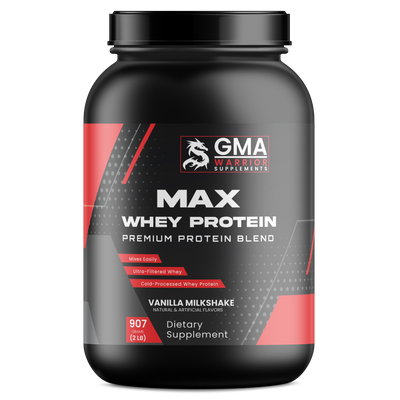
We read our supplement-facts panel before writing this. It lists whey protein isolate as the only protein ingredient, along with the 26 g of protein and the allergens above. Our product page also says isolate increases muscle protein synthesis faster than concentrate. We couldn't find a trial that shows that, and the meta-analysis above found the two forms virtually identical for lean mass, so we are not repeating that claim here. Buy isolate for the leaner label, not for extra muscle. The rest of our protein options are in the Premium Sports Nutrition collection, including our regular Max Whey Protein Vanilla Milkshake.

Sources & Research
- A Castro LH, S de Araújo FH, M Olimpio MY, et al. "Comparative Meta-Analysis of the Effect of Concentrated, Hydrolyzed, and Isolated Whey Protein Supplementation on Body Composition of Physical Activity Practitioners." Nutrients, 2019;11(9):2047. PMID 31480653
- Moore DR, Robinson MJ, Fry JL, et al. "Ingested protein dose response of muscle and albumin protein synthesis after resistance exercise in young men." American Journal of Clinical Nutrition, 2009;89(1):161–168. PMID 19056590
- Witard OC, Jackman SR, Breen L, et al. "Myofibrillar muscle protein synthesis rates subsequent to a meal in response to increasing doses of whey protein at rest and after resistance exercise." American Journal of Clinical Nutrition, 2014;99(1):86–95. PMID 24257722
- Tang JE, Moore DR, Kujbida GW, Tarnopolsky MA, Phillips SM. "Ingestion of whey hydrolysate, casein, or soy protein isolate: effects on mixed muscle protein synthesis at rest and following resistance exercise in young men." Journal of Applied Physiology, 2009;107(3):987–992. PMID 19589961
- Jäger R, Kerksick CM, Campbell BI, et al. "International Society of Sports Nutrition Position Stand: protein and exercise." Journal of the International Society of Sports Nutrition, 2017;14:20. PMID 28642676
- Morton RW, Murphy KT, McKellar SR, et al. "A systematic review, meta-analysis and meta-regression of the effect of protein supplementation on resistance training-induced gains in muscle mass and strength in healthy adults." British Journal of Sports Medicine, 2018;52(6):376–384. PMID 28698222
- Suarez FL, Savaiano DA, Levitt MD. "A comparison of symptoms after the consumption of milk or lactose-hydrolyzed milk by people with self-reported severe lactose intolerance." New England Journal of Medicine, 1995;333(1):1–4. PMID 7776987
- National Institute of Diabetes and Digestive and Kidney Diseases. "Eating, Diet, & Nutrition for Lactose Intolerance." niddk.nih.gov