A vitamin B12 supplement for energy works for one group of people: those who are running low on B12. If your levels are normal, the research says extra B12 won't make you feel more awake or train harder. The real question is whether you're in a group that tends to run low, and a surprising number of adults are. This guide covers what B12 does in your body, who is most likely to be short, how much a supplement needs to deliver, and when to ask your doctor for a blood test.
What Vitamin B12 Actually Does for Energy
B12 doesn't contain energy the way food does. It's a helper. Your body needs it to make healthy red blood cells, which carry oxygen to your muscles. It also helps break down certain fats and amino acids and supports normal nerve function. When B12 runs short for long enough, red blood cell production falls behind and tiredness can follow.
That's where the "B12 for energy" idea comes from, and it's only half the story. A 2004 review of vitamins, minerals and physical performance from the US Department of Agriculture found that severe B12 and folate deprivation reduced endurance work capacity. Short-term, marginal shortfalls didn't change performance measures. And in people already eating an adequate diet, vitamin and mineral supplements did not improve performance. If your B12 is fine, more of it won't feel like a second wind.
Tiredness also has plenty of other causes: short sleep, overtraining, low iron, under-eating, stress. B12 is one item on that list, not the default answer. If you want a short-term lift for a training session, our guide to building a nootropic stack for energy covers the options with real trials behind them.

Who Actually Needs a Vitamin B12 Supplement for Energy
Low B12 is more common than most people assume. In the Framingham Offspring Study, researchers measured blood B12 in 2,999 adults aged 26 to 83. Thirty-nine percent fell below the upper cutoff the researchers used for low-normal status, and 9% were in the clearly low range. There was little difference between younger and older age groups. People who took supplements were less likely to have low levels (8% vs 20% at the middle cutoff). These groups carry the most risk:
- Adults over 50. The Institute of Medicine estimates that 10% to 30% of older people can't properly absorb the B12 that's naturally bound to food, mostly because stomach acid declines with age. Its advice is for people over 50 to get most of their B12 from fortified foods or a supplement, which are absorbed differently. A 2009 review of large US and UK surveys found about 6% of adults 60 and older were deficient and close to 20% had marginal levels.
- Vegans and vegetarians. B12 comes almost entirely from animal foods. A 2013 review of 18 studies found B12 depletion or deficiency among vegetarians regardless of age, location or diet type, with higher rates in vegans. The authors' recommendation was regular use of a B12-containing supplement. If you train plant-based, our whey vs plant protein guide covers the protein side.
- Long-term metformin users. In the Diabetes Prevention Program Outcomes Study, people taking metformin 850 mg twice daily were more likely to have low or borderline B12. At 13 years it was 20.3% vs 15.6% on placebo, and each year of metformin use raised the odds by about 13%. The authors suggested doctors consider routine B12 testing for metformin users.
- Long-term acid-reducer users. A Kaiser Permanente study compared 25,956 people diagnosed with low B12 against 184,199 people without it. Two or more years of proton pump inhibitors (PPIs) was linked to 65% higher odds of low B12. H2 blockers were linked to 25% higher odds.
- Athletes who restrict food. The 2004 USDA review flagged people in weight-class and aesthetic sports as prone to nutrient shortfalls, because they cut total food and often the specific foods that carry those nutrients.
That last group is close to home for us. In more than fifty years of running a martial arts school, we've watched competitors cut hard for a tournament weigh-in and wonder why their legs feel flat. Fighters in our Brazilian Jiu Jitsu program who drop meat, eggs and dairy during a cut are exactly who should keep an eye on B12.

How Much B12 Works, and Why the Label Numbers Look Huge
The adult Recommended Dietary Allowance is just 2.4 mcg a day. So why do supplements carry 500, 1,000 or more? Because absorption drops sharply as the dose goes up. According to the Institute of Medicine, about half of a 1 mcg dose is absorbed. Your body's main uptake system saturates quickly, and with large doses only about 1% gets in by passive absorption. That 1% route works even without the stomach protein (intrinsic factor) that food B12 normally depends on, which is why high-dose supplements can help people who struggle to absorb B12 from food.
The dose research backs this up. In a 2005 Dutch trial, 120 older adults with mildly low B12 took cyanocobalamin daily for 16 weeks at doses from 2.5 to 1,000 mcg. It took roughly 647 to 1,032 mcg a day to get close to the maximum improvement in a blood marker of B12 status. That's more than 200 times the RDA. A 2018 Cochrane review found that 1,000 mcg a day by mouth raised blood B12 about as well as injections in people who were deficient, though it was based on only three small trials.
Safety is reassuring. The Institute of Medicine set no upper limit for B12, noting no adverse effects linked to high supplemental intakes, while cautioning that those studies weren't designed to look for harm. Still, a low risk isn't a reason to take it if you don't need it.
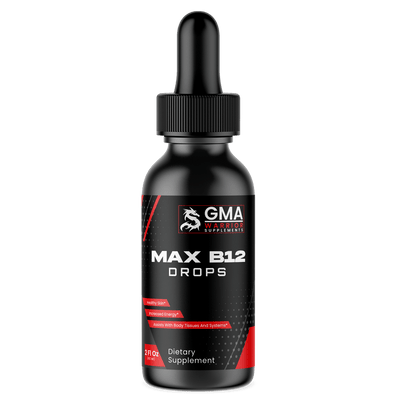
GMA Warrior Max B12 Drops. Here's what the label shows. One 1 ml dropper gives 1,200 mcg of vitamin B12 as cyanocobalamin, the form used in the Dutch dose-finding trial and inside the dose range that study found effective. Each serving also has vitamin B2 (1.7 mg), niacin (20 mg), vitamin B6 (3 mg) and vitamin B5 (20 mg), all of which play roles in energy metabolism. There are 60 servings per 2 oz bottle, and the drops are sweetened with sorbitol and glycerin. They make sense if you're over 50, plant-based, cutting weight or have been told your levels are low. They won't add energy if your B12 is already normal. If you take metformin or an acid reducer, ask your doctor to check your levels before you start.
Shop Max B12 Drops →
Test, Don't Guess
Before you buy a vitamin B12 supplement for energy, get a blood test. If you're in one of the higher-risk groups, or you've been tired for weeks despite decent sleep and food, ask your doctor to check your B12. They may check other blood markers alongside it. The same visit can rule out the other common reasons for fatigue.
See your doctor promptly, rather than self-supplementing, if you have numbness or tingling in your hands or feet, balance problems, memory changes, a sore tongue, or shortness of breath. Those need a proper workup, not a guess. If you're pregnant, nursing, or managing any medical condition, or if you're buying for someone under 18, talk to your healthcare provider before starting B12 or any supplement.
How to Take It
If you and your doctor decide a supplement makes sense, keep it simple:
- Take it daily. The trials that moved blood levels used daily doses for 12 to 16 weeks. Consistency matters more than timing.
- Pick a time you'll remember. Tie it to something you already do every day, like breakfast or packing your gym bag.
- Food still counts. Eggs, fish, meat, dairy and fortified cereals all carry B12. In the Framingham data, people who ate fortified cereal or more dairy were less likely to have low levels.
- Check a multivitamin first. If you already take one, it may cover the RDA. Our guide to choosing a multivitamin for men explains how to read that label.
- Retest. After a few months, a follow-up test tells you whether it's working.
For older athletes, B12 belongs on the same short list as protein, creatine and fish oil. Our guide to supplements for athletes over 40 covers the rest. You'll find Max B12 Drops alongside our other daily basics in the general health collection.
Sources & Research
- Institute of Medicine. "Vitamin B12." In: Dietary Reference Intakes for Thiamin, Riboflavin, Niacin, Vitamin B6, Folate, Vitamin B12, Pantothenic Acid, Biotin, and Choline. National Academies Press, 1998; chapter 9. nap.nationalacademies.org
- Lukaski HC. "Vitamin and mineral status: effects on physical performance." Nutrition, 2004;20(7-8):632–644. PMID 15212745
- Tucker KL, Rich S, Rosenberg I, et al. "Plasma vitamin B-12 concentrations relate to intake source in the Framingham Offspring study." American Journal of Clinical Nutrition, 2000;71(2):514–522. PMID 10648266
- Allen LH. "How common is vitamin B-12 deficiency?" American Journal of Clinical Nutrition, 2009;89(2):693S–696S. PMID 19116323
- Pawlak R, Parrott SJ, Raj S, Cullum-Dugan D, Lucus D. "How prevalent is vitamin B12 deficiency among vegetarians?" Nutrition Reviews, 2013;71(2):110–117. PMID 23356638
- Aroda VR, Edelstein SL, Goldberg RB, et al. "Long-term Metformin Use and Vitamin B12 Deficiency in the Diabetes Prevention Program Outcomes Study." Journal of Clinical Endocrinology & Metabolism, 2016;101(4):1754–1761. PMID 26900641
- Lam JR, Schneider JL, Zhao W, Corley DA. "Proton pump inhibitor and histamine 2 receptor antagonist use and vitamin B12 deficiency." JAMA, 2013;310(22):2435–2442. PMID 24327038
- Eussen SJ, de Groot LC, Clarke R, et al. "Oral cyanocobalamin supplementation in older people with vitamin B12 deficiency: a dose-finding trial." Archives of Internal Medicine, 2005;165(10):1167–1172. PMID 15911731
- Wang H, Li L, Qin LL, et al. "Oral vitamin B12 versus intramuscular vitamin B12 for vitamin B12 deficiency." Cochrane Database of Systematic Reviews, 2018;3:CD004655. PMID 29543316