Walk into any gym an hour before class and half the room is drinking something bright out of a shaker. The question nobody asks out loud is whether it's doing anything. A pre workout for athletes is worth taking seriously — the evidence behind two or three of these ingredients is genuinely strong — but the gap between the doses used in the research and the doses that end up in a scoop is wider than the label suggests.
Here's what the studies actually support: which ingredient earns its place, how much you need, and the part nobody accounts for — how late in the day you can take it.
What a Pre-Workout for Athletes Actually Contains
In 2019, researchers pulled the supplement facts panels on the 100 best-selling pre-workout products and compared every listed dose to the amounts used in the research. The average product carried 18.4 ingredients. Of those, 8.1 sat inside a proprietary blend at undisclosed quantities — 44.3% of all ingredients across the whole sample.
The dose comparison is the part worth reading twice. Beta-alanine appeared in 87% of products at an average of 2.0 g, against a suggested ergogenic dose of 4 g; of the 57 products that disclosed the amount, exactly one cleared the bar. Creatine appeared in 49% at an average of 2.1 g — below the 3 g minimum, and well under the 5 g standard daily dose. Citrulline averaged 4.0 g against a suggested 6 g.
Treat that as a shopping instruction rather than a verdict. A tub that prints each ingredient with its amount lets you check the math; one that hides two-thirds of its formula behind a blend line does not. Our sports nutrition supplements list their ingredient decks openly for that reason, with the supplement facts panel on every product page.

Caffeine Earns Its Place. Most of the Rest Is Negotiable.
Caffeine is the one ingredient in this category with a position stand behind it. The International Society of Sports Nutrition's 2021 review found that caffeine consistently improves exercise performance at 3–6 mg per kilogram of body mass, most commonly taken about 60 minutes before training. For a 170-pound athlete that works out to roughly 230–460 mg. Aerobic endurance shows the most consistent moderate-to-large benefit, with smaller gains in muscular endurance, strength, sprinting and jumping.
Two caveats matter more than the headline. More isn't better — 9 mg/kg produces side effects with no additional performance benefit, and the minimum effective dose may be as low as 2 mg/kg. And caffeine isn't universal. Variation in the CYP1A2 gene means slow metabolizers may perform worse on it, with one reported 13.7% impairment at 4 mg/kg. If caffeine has never felt like it helps you train, that's a real physiological result, not a failure of discipline.
The focus ingredients riding along in most formulas — tyrosine, theanine, choline — support alertness more than performance. We covered where that evidence stands in our guide to nootropic supplements for focus.
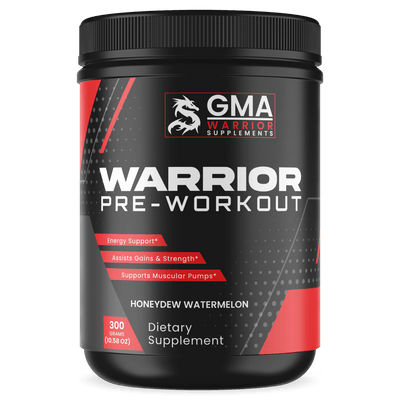
GMA Pre-Workout Watermelon — caffeine anhydrous, L-citrulline malate, creatine monohydrate, N-acetyl tyrosine, L-theanine and Bacopa monnieri, each listed by name rather than buried in a blend, with the full supplement facts panel on the product page. One scoop in 6–8 oz of cold water, 30–45 minutes before you step on the mat.
Shop GMA Pre-Workout →The 7 PM Problem Nobody Puts on the Label
Here's where a martial arts schedule collides with the research. Most adult classes — ours included, as the Global Martial Arts USA class schedule shows — run in the evening, because that's when working adults can train.
A 2023 systematic review of 24 controlled crossover studies quantified what caffeine does to the night that follows. On average it cut total sleep time by 45 minutes, reduced sleep efficiency by 7%, added 9 minutes to how long it took to fall asleep, and cost 11.4 minutes of deep sleep. To avoid that loss of total sleep time, the authors calculated that coffee at 107 mg should stop at least 8.8 hours before bed — and a standard pre-workout serving at 217.5 mg should stop 13.2 hours before bed.
Run that arithmetic against a 7 PM class and an 11 PM bedtime, and a full-caffeine scoop before evening training is a trade, not a free upgrade — you're borrowing sharpness for one hour on the mat against the recovery you'd have spent that night. Train at night regularly? Save the caffeine for morning and weekend sessions and go without, or half-scoop, for the late ones. Sleep does more for a hard week than any pre-workout, the same conclusion we reached reviewing natural sleep supplements.

Food Comes First, and It Isn't Close
The ISSN's nutrient timing position stand puts the pre-training priority on carbohydrate: high-carbohydrate meals or snacks in the range of 1–4 g per kilogram of body weight in the hours before training or competition, with 8–12 g/kg/day the intake that keeps glycogen stores topped up across a heavy week. Protein is handled by the day's total rather than a single pre-session dose — 20–40 g, or 0.25–0.40 g/kg, every three to four hours.
That same stand deflates the anabolic window: muscle stays sensitized to protein for at least 24 hours after a resistance session, so the sprint to the shaker when class ends is optional. Oatmeal with a banana ninety minutes out does more for a hard round than anything in a tub. Not sure what your daily number is? Start with how much protein you really need.

Creatine Belongs in Your Day, Not Your Pre-Workout Window
Creatine is in roughly half of all pre-workouts, and in most of them it's a garnish. Remember the number: an average of 2.1 g per serving, when the supported daily dose is 3–5 g. But the deeper issue is timing. Creatine works by saturating muscle over days of consistent intake, not by hitting your system in the hour before training — which means the dose you skip on a rest day is doing as much damage as the one that's under-portioned.
If creatine is the reason you're buying a pre-workout, buy creatine. A standalone creatine monohydrate powder costs less per gram, gives you the full dose, and gets taken every day rather than only on the days you train. We've covered the timing question in the best time to take creatine and whether front-loading is worth it in the creatine loading phase. Grapplers building a whole stack should start with our guide to BJJ recovery supplements.
None of this is medical advice. Caffeine affects heart rate and blood pressure, so if you're pregnant or nursing, under 18, taking any medication, or managing a health condition, talk to your healthcare provider before adding a stimulant-containing pre-workout — and if a scoop leaves you with a racing heart, chest discomfort or lasting jitters, stop taking it and check in with your doctor. Fifty years of teaching has made the ranking clear enough: sleep, then food, then training, then supplements. A pre-workout can sharpen a good week. It cannot rescue a bad one.
Sources & Research
- Jagim AR, Harty PS, Camic CL. "Common Ingredient Profiles of Multi-Ingredient Pre-Workout Supplements." Nutrients, 2019;11(2):254. PMID 30678328
- Guest NS, VanDusseldorp TA, Nelson MT, et al. "International Society of Sports Nutrition position stand: caffeine and exercise performance." Journal of the International Society of Sports Nutrition, 2021;18(1):1. PMC7777221
- Gardiner C, Weakley J, Burke LM, et al. "The effect of caffeine on subsequent sleep: A systematic review and meta-analysis." Sleep Medicine Reviews, 2023;69:101764. PMID 36870101
- Kerksick CM, Arent S, Schoenfeld BJ, et al. "International society of sports nutrition position stand: nutrient timing." Journal of the International Society of Sports Nutrition, 2017;14:33. PMC5596471