A good face moisturizer for men is not a different product from a good moisturizer for anyone else. What changes is the skin it goes on and what that skin goes through every morning. Men's skin makes more oil, sits at a slightly different pH, and gets scraped with a razor several times a week. Those three facts decide what to look for on the label. This guide covers how male skin differs, what shaving does to it, which ingredients have research behind them, and where sunscreen fits.
How Men's Skin Is Different
The clearest data comes from a 2013 University of Hamburg study that measured 300 healthy adults aged 20 to 74 at five sites, including the forehead and cheek. Three findings matter for choosing a moisturizer:
- Oil. Men produced more sebum than women at every age, and their output stayed steady over time. Women's dropped steadily with age.
- Water. Up to about 50, men's skin lost water more slowly than women's. But hydration in the outer layer of men's skin started falling from around age 40, while women's held steady or rose.
- pH. Men's skin measured below 5 at every site and age. Women's was mostly above 5.
A 2018 review of 57 studies reached a similar picture: men's skin is generally thicker and oilier, with more blood flow and pigment. So the typical male face needs moisture without heaviness, and the need grows after 40. That doesn't mean skipping moisturizer if you're oily. It means choosing a lighter texture.
Why Shaving Changes What a Face Moisturizer for Men Needs to Do
Women don't run a blade over their face five days a week, which is why "for men" isn't pure marketing. Each pass takes off hair and can also scrape the skin's outer surface, the layer that holds water in. Dermatologist Zoe Draelos of Duke University reviewed the research on male skin care in the British Journal of Dermatology in 2012. She points to two needs: keeping hair soft during the shave and restoring hydration afterward. Post-shave moisturizers with glycerin and emollients helped the skin barrier recover, and adding niacinamide improved it further.
The American Academy of Dermatology gives the timing. Apply moisturizer right after you shave or shower, while the skin is still damp, so the cream traps that water instead of letting it evaporate. If you get razor bumps or burn, the AAD also suggests a single- or double-blade razor, shaving with the grain, and not pulling the skin tight. Our men's skincare routine over 40 covers shaving technique step by step.

What to Look For on the Label
Ignore the front of the bottle. The ingredient list on the back tells you whether a moisturizer will do the job. Look for these:
A humectant near the top. Glycerin is the workhorse. A 2008 review in the British Journal of Dermatology found that topical glycerin improves hydration of the outer skin layer, supports barrier function and helps protect against irritation. That covers the main jobs after a shave. Hyaluronic acid works the same way, and our guide to hyaluronic acid serum explains how to layer it.
Barrier support. Niacinamide (vitamin B3) is the ingredient Draelos singled out for shaved skin. In a 2000 study from Kanebo, a Japanese cosmetics company, niacinamide raised ceramide production in skin cells four- to five-fold in the lab. Applied to dry skin, it increased ceramide levels and reduced water loss. Ceramides listed on the label do a similar job directly. Read more in our guide to niacinamide serum.
The right weight for your skin. Most men do best with a lotion or light cream. If you're oily or break out, the AAD recommends products labeled "oil free" or "non-comedogenic," which won't clog pores. If your skin is dry, especially after 40, a richer cream with occlusives such as dimethicone or petrolatum seals water in better. Our dermatologist recommended moisturizer guide matches formulas to skin type in more detail.
Fragrance free. Many men's products lean on a strong scent. The AAD advises "fragrance free" products for sensitive skin, because fragrance can leave skin irritated and dry, and warns that "unscented" products often contain masking fragrances. On skin you've just shaved, that matters more.
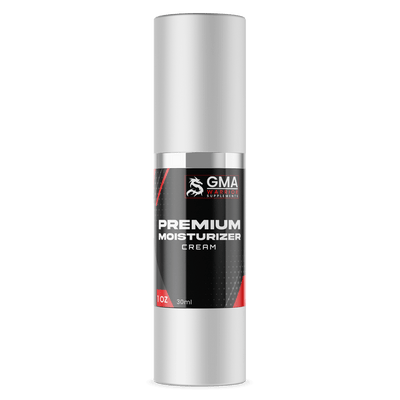
GMA Warrior Premium Moisturizer Cream. Here's what the label actually shows. Glycerin sits high in the ingredient list as the humectant. Sweet almond oil and squalane are the emollients, and dimethicone and mineral oil seal moisture in. There are three peptides (acetyl hexapeptide-8, tripeptide-10 citrulline and tripeptide-1) plus aloe vera, ginseng, cucumber and carrot extracts. No fragrance is listed. What it doesn't have: niacinamide, ceramides or SPF. Use it after your evening shave or shower, and pair it with a separate sunscreen in the morning. Because it contains almond oil, wheat and soy proteins and the preservative diazolidinyl urea, patch-test it on your jaw for a few days if your skin reacts easily.
Shop Premium Moisturizer Cream →
Morning vs Night: Where SPF Fits
The morning moisturizer is the one most men get wrong, because it's the one that should carry sun protection. A CDC survey of 4,033 US adults, published in 2015, found that only 18.1% of men regularly used sunscreen on their face, compared with 42.6% of women. Nearly 40% of the people who did use sunscreen weren't sure if it was broad spectrum.
Daily protection does more than block new damage. In a one-year study, 32 adults applied a broad-spectrum SPF 30 sunscreen to their whole face every day. Dermatologists rated every sign of sun damage as improved by week 12, and texture, clarity and pigment improved 40% to 52% by the end of the year. The study had no comparison group, so read it as encouraging rather than proof. The AAD's standard is broad spectrum, SPF 30 or higher, reapplied every two hours or right after sweating.
So the simplest setup is two products. In the morning, use a moisturizer with SPF 30 or a plain moisturizer followed by sunscreen. At night or after your shave, use a moisturizer without SPF, which can be richer because it doesn't have to sit under the sun.

How to Use It, and When to See a Dermatologist
A pea- to dime-sized amount covers the face and neck. Apply it within a few minutes of washing or shaving, while the skin is still damp. Work it into the beard line as well, since the skin under facial hair can dry out too. Use it twice a day. If you train, wash your face after class and moisturize then. In more than fifty years of running a martial arts school, we've seen what sweat, mat contact and a morning shave do to a man's skin over a training week.
Give a new face moisturizer for men two to four weeks before you judge it. Hydration feels better within days, but barrier repair takes longer. See a dermatologist if you get a rash, burning that doesn't settle, persistent bumps along the jaw and neck, or if you have eczema, rosacea or acne that isn't responding to basic care. Any spot that is new, itching, bleeding or changing color needs a professional look, not a cream.
To build the rest of your routine, browse our premium skin care collection and our guide to peptide serum.
Sources & Research
- Luebberding S, Krueger N, Kerscher M. "Skin physiology in men and women: in vivo evaluation of 300 people including TEWL, SC hydration, sebum content and skin surface pH." International Journal of Cosmetic Science, 2013;35(5):477–483. PMID 23713991
- Rahrovan S, Fanian F, Mehryan P, Humbert P, Firooz A. "Male versus female skin: What dermatologists and cosmeticians should know." International Journal of Women's Dermatology, 2018;4(3):122–130. PMID 30175213
- Draelos ZD. "Male skin and ingredients relevant to male skin care." British Journal of Dermatology, 2012;166 Suppl 1:13–16. PMID 22385030
- Fluhr JW, Darlenski R, Surber C. "Glycerol and the skin: holistic approach to its origin and functions." British Journal of Dermatology, 2008;159(1):23–34. PMID 18510666
- Tanno O, Ota Y, Kitamura N, Katsube T, Inoue S. "Nicotinamide increases biosynthesis of ceramides as well as other stratum corneum lipids to improve the epidermal permeability barrier." British Journal of Dermatology, 2000;143(3):524–531. PMID 10971324
- Holman DM, Berkowitz Z, Guy GP Jr, et al. "Patterns of sunscreen use on the face and other exposed skin among US adults." Journal of the American Academy of Dermatology, 2015;73(1):83–92. PMID 26002066
- Randhawa M, Wang S, Leyden JJ, et al. "Daily Use of a Facial Broad Spectrum Sunscreen Over One-Year Significantly Improves Clinical Evaluation of Photoaging." Dermatologic Surgery, 2016;42(12):1354–1361. PMID 27749441
- American Academy of Dermatology. "Skin care tips for men." aad.org