Walk down any skincare aisle and you'll see it on a dozen labels, but a vitamin C serum for skin is one of the few topical ingredients with decades of dermatology research behind it. Used correctly, it does three things the science actually supports: it defends your skin against daily environmental damage, it helps your body build the collagen that keeps skin firm, and it evens out tone and brightness over time. Used incorrectly — wrong concentration, wrong storage, no sunscreen to back it up — it does very little except oxidize in the bottle.
This guide cuts through the marketing. We'll cover what vitamin C does at the skin level, how to read a label so you actually buy something that works, how to fit it into a routine, and what results are realistic. The same standard we hold for every supplement we make at GMA Warrior Supplements — evidence over hype — applies here too.
What a Vitamin C Serum Actually Does for Your Skin
Vitamin C (ascorbic acid) is a potent antioxidant. Your skin is exposed to ultraviolet light and pollution all day, and that exposure generates reactive oxygen species — unstable molecules that damage cells and accelerate visible aging. Topical vitamin C helps neutralize those free radicals at the surface, which is why dermatology reviews describe it as a complement to sunscreen rather than a replacement for it.
Its second job is structural. Vitamin C is a required cofactor for the enzymes that build collagen, the protein that gives skin its firmness and bounce. It supports the hydroxylation of proline and lysine — the chemistry that stabilizes new collagen — and research suggests it also helps limit matrix metalloproteinase-1 (MMP-1), the enzyme that breaks collagen down after UV exposure. In plain terms, a good premium skin care routine built around vitamin C supports the skin's own repair systems instead of just sitting on top of them.
Third is brightness. Vitamin C inhibits tyrosinase, the rate-limiting enzyme in melanin production, which is why it's used to help fade dark spots and even out uneven tone. It won't bleach your skin, and it won't erase a sunspot overnight — but consistent use is one of the better-supported approaches to a more uniform complexion.
Worth understanding: most of this work happens at the surface and just below it. A serum is a thin, fast-absorbing delivery format designed to carry a high concentration of active ingredient into the upper layers of skin, which is exactly why vitamin C is so often sold as a serum rather than buried in a thick cream. That same delivery efficiency is also why formulation quality matters so much — a poorly stabilized serum can lose most of its potency before it ever reaches your skin.

Concentration, Form, and pH: How to Choose a Vitamin C Serum
Not all vitamin C serums are created equal, and the differences are on the label if you know what to look for. The most studied form is L-ascorbic acid — pure vitamin C. Research points to a concentration of roughly 10–20%, formulated at a low pH (about 2.5–3.5), as the range where the molecule actually penetrates the skin barrier and does its work. Efficacy climbs with concentration up to about 20%, then plateaus, so a higher number on the box is not automatically better.
For most people, 10% L-ascorbic acid is the sweet spot — it balances proven results against the risk of irritation. If your skin is sensitive or reactive, start lower (around 5%) and build tolerance. Strengths near 20% are best reserved for resilient skin targeting stubborn photodamage. If pure L-ascorbic acid stings or you want something gentler, look for stable derivatives like 3-O-ethyl ascorbic acid or sodium ascorbyl phosphate, which tolerate higher pH and oxidize more slowly.
One more label cue: vitamin C is notoriously unstable and degrades when exposed to air, heat, and light. Quality formulas are sold in opaque or amber, air-restrictive packaging, and the best-studied combinations pair vitamin C with vitamin E and ferulic acid, which stabilize the formula and measurably boost its antioxidant and photoprotective effect. A serum that has turned dark yellow or brown has oxidized — it's past its useful life.
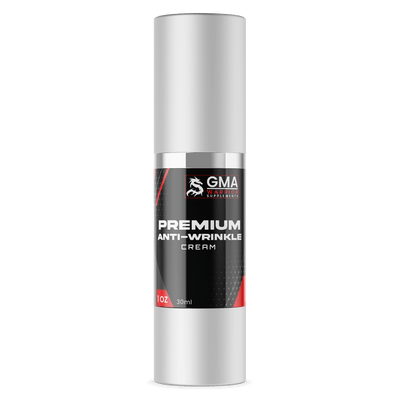
GMA Warrior Premium Anti-Wrinkle Cream — an antioxidant-rich, USA-made formula with botanical extracts that pairs naturally with a vitamin C serum to support firmer, brighter-looking skin.
Shop Premium Anti-Wrinkle Cream →How to Use Vitamin C Serum in Your Routine
The application order is simple: cleanse, apply your vitamin C serum to dry skin, let it absorb for a minute, then follow with moisturizer and — in the morning — sunscreen. Most dermatologists favor applying vitamin C in the AM, because its antioxidant protection complements your sunscreen against daytime UV and pollution. It can be used at night too; the key is consistency, not the exact hour.
A few practical rules. Use a thin layer — a few drops covers the whole face; more is not better. If you're new to it, apply every other day for the first week or two and build to daily use once your skin adjusts. And do not skip sunscreen: vitamin C supports your skin's defenses, but it is not an SPF. The two are partners, not substitutes. For a fuller breakdown of which actives belong together, see our guide to the ingredients in an effective anti-wrinkle serum.

What Results to Realistically Expect
Skincare works on a biological timeline, not a marketing one. With consistent daily use, most people notice improvements in brightness and a more even tone first — often within four to eight weeks. Changes tied to collagen, such as firmness and the look of fine lines, build more slowly and generally need a few months of steady use to become visible. The people who benefit most are those dealing with dullness, uneven tone, early signs of sun-related aging, or scattered dark spots.
Vitamin C also works best as part of a stack, not a solo act. A common evidence-based pairing is vitamin C in the morning for antioxidant defense and a retinoid at night to support cell turnover, with daily sunscreen tying the routine together. You don't have to use every active to see results — consistency with two or three well-chosen steps beats an elaborate ten-step routine you can't maintain. Pick what fits your skin and your schedule, and give it time to work.
Manage expectations honestly: a topical vitamin C serum supports healthier-looking skin, but it doesn't reverse deep wrinkles or replace professional treatment for significant concerns. It pairs well with other evidence-based steps — daily sunscreen, retinoids at night, and good nutrition. If you're curious whether ingested collagen adds anything on top of a topical routine, we covered the evidence in our guide to collagen supplements for skin.
Common Mistakes and Side Effects to Avoid
The most common mistake isn't application — it's storage. Because L-ascorbic acid oxidizes on contact with air and light, leaving the cap off or keeping the bottle on a sunny windowsill quietly destroys what you paid for. Store it somewhere cool and dark, close it tightly, and replace it once it darkens.
The second mistake is reaching for the highest concentration available. Strong vitamin C can cause tingling, redness, or dryness, especially on sensitive skin, and 20% is rarely worth the irritation for a first-time user. Start moderate, patch test a new product on your inner forearm for a couple of days before using it on your face, and introduce it gradually. If you use other strong actives like exfoliating acids, separate them to different times of day to reduce the chance of irritation.
Vitamin C is well tolerated for most people, but skincare is personal. If you have a known skin condition, are pregnant, or react to a new product, stop and consult your healthcare provider or a dermatologist before continuing — that's the same principle we apply to every formula we recommend. Built by martial artists in Gallatin, TN with more than 50 years of coaching behind us, GMA Warrior's standard is the same on the mats as it is on the label: do the work, respect the process, and don't fall for shortcuts.

Sources & Research
- Makhakhe L. "The role of vitamin C on the skin." South African Family Practice, 2025;67(1). ncbi.nlm.nih.gov
- Al-Niaimi F, Chiang NYZ. "Topical Vitamin C and the Skin: Mechanisms of Action and Clinical Applications." Journal of Clinical and Aesthetic Dermatology, 2017. jcadonline.com
- "A Double-Blinded, Split-Face Clinical Trial Evaluating a Vitamin C, E, and Ferulic Acid Serum Combined with Microneedling on Facial Photoaging." PMC, 2025. ncbi.nlm.nih.gov
- Cleveland Clinic. "Vitamin C Serum: Benefits and How To Use It." health.clevelandclinic.org