Walk down the skincare aisle and you'll find dozens of products promising to erase years from your face overnight. Choosing the right anti wrinkle serum shouldn't require a chemistry degree — but understanding what actually works does require knowing which ingredients have clinical evidence behind them and which are riding on marketing alone.
This guide cuts through the noise. We'll break down the four ingredients with the strongest research backing, explain how they work at the cellular level, and give you a practical framework for building a serum routine that delivers visible results over time — not empty promises.
What Makes a Serum Different from a Cream or Moisturizer
Serums and creams aren't interchangeable. A serum is a lightweight, fast-absorbing liquid with a high concentration of active ingredients. Because serums use smaller molecules and water-based or oil-based carriers, they penetrate deeper into the skin than heavier creams. That deeper delivery makes serums the vehicle of choice for potent actives like retinoids, vitamin C, and peptides.
A moisturizer or cream, on the other hand, forms a protective barrier on the skin's surface. It locks in hydration and shields against environmental stressors, but it doesn't deliver actives as deeply. The smart move is using both: apply your serum first to deliver targeted ingredients, then layer a quality anti-aging cream on top to seal everything in.
If you're building a full routine from scratch, our guide to building an anti-wrinkle skin care routine for every age walks you through the complete layering sequence by decade.

Four Anti-Wrinkle Serum Ingredients with Real Clinical Evidence
Not every ingredient that shows up on a label has meaningful research behind it. These four do — with peer-reviewed studies, controlled trials, and measurable outcomes.
Retinoids (Vitamin A Derivatives)
Retinoids remain the most well-studied class of anti-aging compounds in dermatology. A comprehensive review published in Clinical Interventions in Aging confirmed that topical retinoids promote cell turnover, stimulate collagen synthesis, and inhibit the enzymes (matrix metalloproteinases) that break down collagen and elastin fibers. A 2022 focused review of clinical evidence found that retinol concentrations between 0.25% and 1% produced statistically significant improvements in fine lines, wrinkle depth, and skin texture over 8 to 24 weeks of consistent use.
The strongest prescription-grade retinoid is tretinoin. Over-the-counter serums typically use retinol, retinaldehyde, or retinyl palmitate — milder forms that convert to retinoic acid in the skin. They work, but they take longer to show results and cause less irritation in the process.
Vitamin C (L-Ascorbic Acid)
Vitamin C is a potent antioxidant that neutralizes free radicals generated by UV exposure and pollution. Beyond its protective role, it directly supports collagen production by serving as a cofactor in the hydroxylation of proline and lysine — two amino acids essential for stable collagen structure. Research published in the journal Molecules documented that topical vitamin C improved skin elasticity, reduced fine lines, and helped even out pigmentation when used consistently at concentrations of 10–20%.
Stability is the catch. L-ascorbic acid oxidizes quickly when exposed to light and air. Look for serums packaged in dark, airtight bottles with a pH below 3.5 — that's where absorption is highest.
Peptides
Peptides are short chains of amino acids that act as signaling molecules in the skin. When applied topically, certain peptides can stimulate fibroblasts to produce more collagen, elastin, and hyaluronic acid. A clinical study published in the International Journal of Cosmetic Science found that a peptide-and-vitamin-C formulation decreased the number of visible wrinkles by 11.5% after just 29 days of application compared to baseline.
The peptide landscape is broad. Matrixyl (palmitoyl pentapeptide-4) and copper peptides have the strongest independent evidence. Signal peptides tell skin cells to ramp up collagen production, while carrier peptides deliver trace minerals like copper that support enzymatic skin repair.
Hyaluronic Acid
Hyaluronic acid isn't an anti-aging active in the same sense as retinoids or vitamin C — it doesn't restructure skin cells or boost collagen directly. What it does is hold up to 1,000 times its weight in water, which plumps fine lines from the surface and creates an immediate smoothing effect. It also supports the skin's moisture barrier, making it a critical supporting ingredient in any anti wrinkle serum formula.
For best results, look for serums that combine multiple molecular weights of hyaluronic acid. Larger molecules hydrate the surface layer, while smaller fragments penetrate deeper to support hydration at the dermal level.

How These Ingredients Work at the Skin Level
Wrinkles form through two parallel processes: intrinsic aging (genetic, time-driven) and extrinsic aging (UV damage, pollution, lifestyle). Both pathways converge on the same structural outcome — the breakdown of collagen and elastin in the dermis, the skin's middle layer where its structural scaffolding lives.
Retinoids address this by binding to retinoic acid receptors in skin cells, activating genes that accelerate cell turnover and upregulate procollagen synthesis. Vitamin C works alongside by scavenging free radicals before they can trigger oxidative stress, while also directly participating in the collagen synthesis pathway as an enzymatic cofactor. Peptides add a third layer by sending biochemical signals to fibroblasts — the cells responsible for producing collagen — telling them to ramp up output.
Hyaluronic acid rounds out the picture by maintaining the hydration environment that all these processes depend on. Dehydrated skin shows wrinkles more prominently and heals more slowly. A well-hydrated dermis gives retinoids, vitamin C, and peptides the best conditions to do their work.
This is why multi-ingredient serums often outperform single-ingredient formulas — the actives reinforce each other through different mechanisms rather than competing for the same pathway.
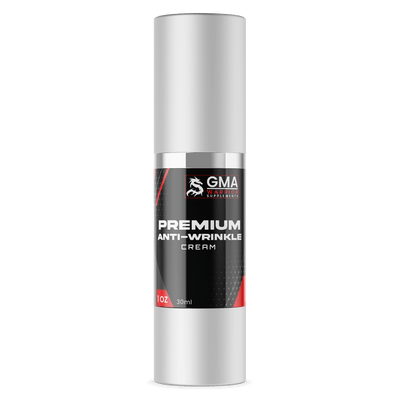
GMA Warrior Premium Anti-Wrinkle Cream — formulated with aloe vera, ginseng, cucumber, and carrot extract to support skin hydration and reduce the appearance of fine lines. Pair it with your serum for a complete anti-aging routine.
Shop Anti-Wrinkle Cream →How to Choose the Right Anti-Wrinkle Serum
The sheer number of options can be paralyzing, but narrowing your choice comes down to three practical factors.
Your primary concern. If fine lines and texture are your main focus, a retinol-based serum is your strongest option. If dullness, uneven tone, or sun damage is the bigger issue, lead with vitamin C. If you're dealing with dryness-driven wrinkles, a hyaluronic acid serum with peptides may give you the fastest visible improvement.
Your skin's tolerance. Retinoids are the gold standard, but they can cause dryness, peeling, and irritation — especially at higher concentrations or if you've never used them before. Start at 0.25% retinol and build up over 4–6 weeks. Vitamin C serums at 10–20% L-ascorbic acid can sting sensitive skin; buffered forms like sodium ascorbyl phosphate are gentler alternatives. Peptide serums are generally well-tolerated across all skin types.
Formulation quality. Active ingredients degrade without proper packaging and stabilization. Retinol and vitamin C should be in opaque, airtight containers. Check for unnecessary fillers, artificial fragrances, and long ingredient lists that bury the actives deep in the formula — concentration matters, and ingredients listed near the bottom are present at negligible levels.
How to Apply Anti-Wrinkle Serum for Best Results
Application technique matters almost as much as the formula itself. A good serum used wrong delivers less than a decent serum used right.
Cleanse first. Apply serum to clean, slightly damp skin. Residual makeup, sunscreen, or oil creates a barrier that blocks absorption. A gentle cleanser — not a harsh scrub — is all you need.
Use the right amount. Two to three drops is enough for the entire face. More product doesn't mean faster results — it means wasted product sitting on the surface instead of absorbing.
Pat, don't rub. Press the serum into your skin with your fingertips using light tapping motions. Rubbing can cause irritation, especially with retinoids, and doesn't improve absorption.
Layer correctly. If you use multiple serums, apply from thinnest to thickest consistency. Water-based serums go on first, oil-based serums second. Follow with your moisturizer or anti-wrinkle cream to lock everything in.
Be consistent. Clinical studies showing measurable wrinkle reduction used their test products daily for 8 to 24 weeks. A serum used three times a week won't match the results of one used every day. Pick a routine you can actually stick with — consistency always beats intensity.
Wear sunscreen. Retinoids and vitamin C both increase photosensitivity. Using an anti wrinkle serum without daily SPF 30+ protection is counterproductive — you're boosting cell turnover while leaving new skin unprotected from the UV damage that caused the wrinkles in the first place.

Sources & Research
- Mukherjee, S., et al. "Retinoids in the treatment of skin aging: an overview of clinical efficacy and safety." Clinical Interventions in Aging, 2006. PMC2699641
- Zasada, M., and Budzisz, E. "Use of Retinoids in Topical Antiaging Treatments: A Focused Review of Clinical Evidence for Conventional and Nanoformulations." Advances in Dermatology and Allergology, 2022. PMC9618501
- Shen, Y., et al. "Research Progress on Skin Aging and Active Ingredients." Molecules, 2023. PMC10385838
- Errante, F., et al. "Effectiveness of a formulation containing peptides and vitamin C in treating signs of facial ageing." International Journal of Cosmetic Science, 2020. PubMed 33038010