Almost everyone who buys their first bottle asks the same question within a week: how much of this am I supposed to be using? Working out how often to use retinol matters more than the brand on the bottle or the number on the label. It is the one lever that decides whether you get the results the research actually supports, or a peeling face and a bottle shoved to the back of a drawer by week three.
The honest answer isn't "every night." It's "as often as your skin will let you" — and for many people that number is lower than expected, without costing them anything. Here's what the evidence supports for starting frequency, what sets your personal ceiling, and how often you need to keep going once you have results.
How Often to Use Retinol When You're Starting Out
The American Academy of Dermatology's guidance is refreshingly blunt: start with the least potent formulation you can find, apply it every other night, and build up slowly as your skin adapts. If your skin runs dry or reactive, two nights a week is a safer opening still.
The reason isn't caution for its own sake. The first few weeks are when people quit — retinoid irritation clusters in exactly that window, so someone who goes nightly on day one tends to meet dryness and flaking by week two, stop, and conclude that retinol "doesn't work for them." The ramp exists to get you past that window with the bottle still in rotation.
A schedule that suits most people: two nights a week for the first two to three weeks, every other night through weeks four to eight, then more only if your skin stays comfortable. If a step feels rough, hold there another two weeks rather than pushing through. There's no prize for reaching nightly use quickly — it's the same principle we've taught white belts for fifty years. The student who paces the ramp is the one still training a year later.
Apply it at night, on dry skin, a pea-sized amount for the whole face. For the mechanics — the moisturizer sandwich, what to leave out on retinol nights — see our guide to how to use retinol without irritation.

Two or Three Nights a Week Is Not a Consolation Prize
The most useful fact about retinol frequency is that the landmark trial behind retinol's anti-aging reputation did not use it nightly.
In a randomized, double-blind, vehicle-controlled study published in Archives of Dermatology, researchers applied 0.4% retinol lotion to one arm and its vehicle to the other in 36 older adults with a mean age of 87 — up to three times a week for 24 weeks. The retinol-treated arms showed significantly greater improvement in fine wrinkling than the vehicle arms, and biopsies confirmed the change wasn't superficial: both glycosaminoglycan and procollagen I increased in the treated skin.
That is measurable structural change in skin that had been aging for eight decades, on three nights a week. Settle at three and never reach seven and you aren't running a watered-down version of retinol — you're running roughly the schedule that generated the evidence everyone quotes. Consistency across months beats intensity in any given week: three nights sustained for a year beats nightly use abandoned in February.
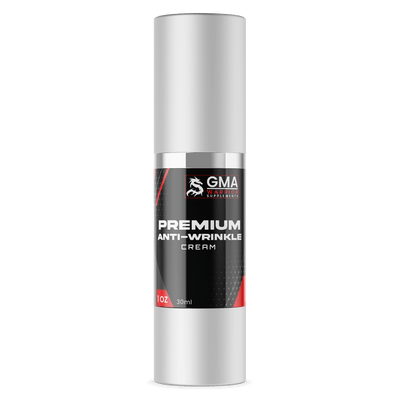
GMA Warrior Premium Anti-Wrinkle Cream — we don't make a retinol product and we won't imply otherwise. What this aloe- and ginseng-based cream does is the job that actually sets your frequency: keeping the barrier calm and cushioned on the nights in between.
Shop Premium Anti-Wrinkle Cream →What Actually Sets Your Ceiling
Your maximum sustainable frequency isn't a number you pick — it's one your skin hands you, and a few things decide it.
Strength. A 15-year cohort study of 753 patients found that a higher tretinoin concentration (0.1%) was associated with significantly more intolerability. Concentration and frequency trade against each other, which means a stronger product twice a week may suit you better than a mild one every night.
Your own skin. That same cohort reported intolerability in 12.4% of Asian patients, 8.8% of White patients and 3.2% of Black patients, and better tolerance in men than women. It's a single-center retrospective study in acne patients, so it predicts nothing about you individually — but it does confirm the "right" frequency genuinely differs between people. The AAD adds that in deeper skin tones irritation can trigger hyperpigmentation, which is an argument for ramping slower, not faster.
The rest of your routine. Exfoliating acids, benzoyl peroxide and a strong vitamin C serum all draw on the same tolerance budget. Use them and your retinol ceiling drops.
The season. Cold, dry winter air lowers the frequency most people can hold; dropping from four nights to two in January is calibration, not backsliding. Barrier support on the off-nights is what raises the ceiling over time, and a plain, well-built moisturizer on non-retinol nights does more for tolerance than anything sold as a retinol booster.

Maintenance: The Frequency That Holds Your Results
Once you have the results, do you have to keep going at the same rate? A 1997 study in the Journal of the American Academy of Dermatology tested precisely that. After 126 people completed 48 weeks of once-daily tretinoin, they were split for another 24 weeks into three maintenance groups: once weekly, three times weekly, or no treatment at all. The improvement they had built was sustained with three-times-weekly application, held up less well at once weekly, and tended to regress in the group that stopped.
Two things follow. These results are rented rather than owned — stop entirely and skin drifts back toward where it started. But you don't have to defend your peak frequency forever: if you climbed to nightly use to get here, three nights a week is a well-supported place to settle, with less irritation and a bottle that lasts three times as long.
Expect a slow timeline either way. Fine lines and tone shift over three to six months, not weeks. Our week-by-week look at before and after retinol results covers what changes and when.
When to Dial It Back — and How to Restart
Some dryness, tightness and flaking in the first several weeks is the adjustment period, not a verdict. Drop a night or two rather than quitting: two nights a week continued beats seven nights abandoned.
Coming back after a break — travel, a bad stretch, a forgotten bottle — means restarting the ramp rather than resuming where you left off, because tolerance fades when you stop. Go back to twice a week and rebuild.
Stop and see a board-certified dermatologist if irritation keeps worsening past six weeks, or if you get intense stinging, swelling or raw patches. Retinoids should not be used during pregnancy, and if you're nursing, planning a pregnancy, or using prescription retinoids or other skin medications, talk to your healthcare provider before starting or changing any retinol routine. Nothing here is medical advice.
Whatever cadence you land on, wear sunscreen every morning — retinol increases sun sensitivity, which is why it stays night-only at any frequency. It anchors a serious premium skin care routine for good reason, but only for people who stay on it. Pick the frequency you'll actually keep.

Sources & Research
- Kafi R, Kwak HS, Schumacher WE, et al. "Improvement of Naturally Aged Skin With Vitamin A (Retinol)." Archives of Dermatology, 2007;143(5):606–612 — 0.4% retinol lotion applied up to 3×/week for 24 weeks significantly improved fine wrinkling, with increased glycosaminoglycan and procollagen I. pubmed.ncbi.nlm.nih.gov
- Olsen EA, et al. "Sustained improvement in photodamaged skin with reduced tretinoin emollient cream treatment regimen: effect of once-weekly and three-times-weekly applications." J Am Acad Dermatol, 1997;37(2):227–230 — 126 subjects; gains sustained at three times weekly, less at once weekly, regressing off therapy. pubmed.ncbi.nlm.nih.gov
- Chang Y-F, Chen L-C, Kim DH, Hsu SH, Chung HJ. "Racial differences in tolerability of topical retinoids: A 15-year single-center retrospective cohort study." JAAD International, 2024;16:122–124 — 753 patients; intolerability 12.4% Asian / 8.8% White / 3.2% Black, and higher tretinoin concentration associated with greater intolerability. pmc.ncbi.nlm.nih.gov
- American Academy of Dermatology. "Retinoid or Retinol?" — start with the least potent formulation every other night and build slowly; night-only use, daily sun protection, no retinoids in pregnancy. aad.org