Walk down any supplement aisle or scroll social media for ten seconds and you'll find a tub of green powder promising to replace your vegetables, flatten your bloating, and hand you back your energy. The marketing is loud. The research is much quieter. Here's the honest version: some greens powder benefits do hold up in controlled trials, several don't, and the single biggest selling point — that one scoop stands in for a salad — falls apart the moment you read a nutrition label.
We've spent 50+ years coaching athletes, and we've watched a lot of expensive powders come and go through gym bags. Below is what the evidence actually supports, what it doesn't, the safety problem nobody prints on the front of the tub, and how to decide whether a greens powder deserves a place in your routine.
What's Actually Inside a Greens Powder
Most greens powders are a blend of dehydrated vegetables and leafy greens, cereal grasses like wheatgrass and barley grass, algae such as spirulina and chlorella, fruit powders for flavor, and then a stack of add-ons: vitamins, minerals, digestive enzymes, probiotic strains, and adaptogenic herbs. Some tubs list 75 ingredients. That sounds impressive until you look at how they're disclosed.
The catch is the proprietary blend. Most labels give you the total weight of a blend — say, 8 grams of a "Super Greens Matrix" — without telling you how much of that is spirulina and how much is filler sitting at the bottom of the list. You could be getting a research-backed dose of one ingredient and a decorative pinch of the other 74. That's the opposite of how we build every formula in our general health supplements line, and it's the first thing to check before you spend $80 on a tub.

The Greens Powder Benefits That Actually Have Research Behind Them
The best evidence doesn't come from the scoopable tubs at all — it comes from encapsulated fruit and vegetable juice concentrates, which have been studied for two decades. Esfahani and colleagues reviewed 22 clinical interventions using commercially available mixed fruit and vegetable concentrates and found a consistent pattern: daily use raised blood concentrations of the major antioxidant vitamins, lowered several markers of oxidative stress and inflammation, and showed promising signals for immune and endothelial function. No serious adverse effects were reported across the studies.
One of the better-controlled trials backs that up. Lamprecht and colleagues randomized 42 women to eight weeks of an encapsulated fruit, berry, and vegetable juice powder or a placebo. The supplement group saw significant reductions in oxidized LDL, carbonyl proteins, and TNF-α compared with placebo, along with measurable improvements in skin blood flow and oxygen saturation.
That's a real result, and it's worth taking seriously. It's also worth reading honestly. Those trials used capsuled juice concentrates from a specific product family, not the 75-ingredient scoops dominating shelves today. The sample sizes were small, the durations were short, and the outcomes were blood markers — not disease outcomes, not performance, not "more energy." The fair summary: a quality concentrate can support your body's antioxidant status and healthy inflammatory balance. It is not a transformation in a tub.
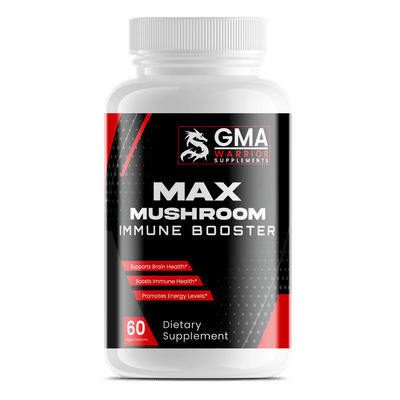
GMA Max Mushroom Immune Booster — if you want a whole-food botanical concentrate, take one with the ingredients actually named and dosed on the label: cordyceps, lion's mane, reishi, chaga, and turkey tail, third-party tested, no proprietary blend hiding the numbers.
Shop Max Mushroom Immune Booster →What a Scoop of Greens Can't Do
Here's where the marketing outruns the label. Most greens powders deliver roughly 1 to 2 grams of fiber per serving. The Adequate Intake set by the National Academies is 25 grams a day for women and 38 grams for men, and most Americans land closer to 17. A single pear will beat an entire scoop of greens on fiber, and it costs about a dollar.
Fiber isn't a footnote — it's most of the point. It's what feeds the bacteria in your gut, what slows digestion, and what gives vegetables their volume and staying power at a meal. Strip a plant down to a dry powder and you keep some vitamins and polyphenols, but you lose the water, the bulk, and most of the fiber. If gut health is your actual goal, real fiber plus a targeted 40-billion-CFU probiotic is the better-supported route — our guide to probiotics for gut health covers how strains and doses actually work.
The vegetable gap that greens powders were invented to solve is genuinely real. CDC surveillance found that only about 9% of U.S. adults met the federal vegetable recommendation and 12% met the fruit recommendation. But a scoop doesn't close that gap; it just makes it feel closed. That distinction matters more than any claim on the tub.

The Safety Issue Nobody Prints on the Front of the Tub
This is the part that gets skipped, and it's the part we'd want a family member to read. Independent testing by the Clean Label Project examined 37 best-selling greens and spirulina products and found 10 greens powders exceeded California Proposition 65's warning level for lead of 0.5 micrograms per day — including 8 of the 13 organic mixed greens powders and 2 of the 3 conventional ones tested. Every high-lead finding was confirmed by an ISO-certified third-party laboratory.
The mechanism isn't sinister, just physical. Plants pull up whatever is in the soil they grew in, and concentrating a large volume of plants into one scoop concentrates the trace metals right along with the nutrients. "Organic" describes how a crop was farmed, not what the soil contained — which is why organic products fared no better in that testing. Third-party heavy-metal testing on the specific lot is the only thing that answers the question, and any brand doing it will tell you so plainly.
One more caution worth naming: leafy greens are rich in vitamin K, and a concentrated powder can carry a meaningful amount. If you take warfarin or another anticoagulant, sudden swings in vitamin K intake can interfere with how the medication works — talk to your healthcare provider before adding or dropping a greens powder. The same goes if you're pregnant or nursing, under 18, taking any prescription medication, or managing a medical condition. This isn't a category where you guess.
Who Should Actually Take One — and How to Choose
There's a reasonable case for a greens powder, and it's narrower than the ads suggest. If you're traveling for two weeks, working nights, deep in a brutal training block, or genuinely not getting produce on your plate, a quality concentrate is a defensible insurance policy for your antioxidant vitamin intake. What it isn't is a replacement for the vegetables you'd otherwise eat, or a reason to stop trying.
If you decide to buy one, four filters do most of the work. Demand third-party testing for heavy metals, and look for a brand that publishes it. Skip proprietary blends — you want each ingredient's dose on the label. Be suspicious of ingredient counts that read like a phone book, because 75 ingredients in 10 grams means nothing is dosed meaningfully. And judge it as a supplement to your diet, not a substitute for it.

The students and fighters we coach at our martial arts school in Gallatin, TN hear the same thing every time this comes up: the people who recover best and train longest aren't the ones with the fullest supplement shelf. They're the ones who eat real food most days and stay consistent. If you want supplements that earn their keep on top of that foundation, the evidence is far stronger for the basics — start with fish oil benefits and, if inflammation and joints are your concern, what the research actually shows about turmeric benefits. Greens powders can ride along. They just shouldn't drive.
Sources & Research
- Esfahani A, Wong JMW, Truan J, et al. "Health Effects of Mixed Fruit and Vegetable Concentrates: A Systematic Review of the Clinical Interventions." Journal of the American College of Nutrition, 2011;30(5):285–294. tandfonline.com
- Lamprecht M, Obermayer G, Steinbauer K, et al. "Supplementation with a juice powder concentrate and exercise decrease oxidation and inflammation, and improve the microcirculation in obese women: randomised controlled trial data." British Journal of Nutrition, 2013;110(9):1685–1695. pmc.ncbi.nlm.nih.gov
- Lee-Kwan SH, Moore LV, Blanck HM, et al. "Disparities in State-Specific Adult Fruit and Vegetable Consumption — United States, 2015." MMWR Morbidity and Mortality Weekly Report, 2017;66(45):1241–1247. cdc.gov
- Clean Label Project. "Greens Powder and Spirulina Heavy Metals Testing" (37 products tested 2024–2025; independently confirmed by an ISO-certified laboratory). nutraceuticalsworld.com