Walk down any supplement aisle and the whey vs plant protein question hits you before you've picked up a single tub: one wall of dairy-based powders, one wall of pea-and-rice blends, and a lot of confident marketing on both sides. The honest answer is less dramatic than either camp wants it to be. Whey holds a small, measurable edge in one specific area. In another — the one most people training hard actually care about — the two are a statistical tie. And the gap that does exist is closeable if you know which lever to pull.
Here's what the research actually shows, what it doesn't, and how to pick the powder that fits your body and your training instead of the one with the loudest label.
Whey vs Plant Protein: What's Actually Different
Both deliver protein. The difference is in the amino acid profile — specifically how much leucine each scoop carries, and how well your body absorbs the rest of what's in there.
Leucine is the amino acid that acts as the trigger for muscle protein synthesis. Whey is unusually leucine-dense, which is most of its reputation. Pea protein carries less. Rice protein carries less still and runs short on lysine specifically, which is why single-source rice powders are the weakest option on the shelf.
Protein quality gets formally scored using DIAAS (Digestible Indispensable Amino Acid Score). In Herreman and colleagues' 2020 overview in Food Science & Nutrition, whey scored 85 ± 10.8, soy 91 ± 11.5, pea 70 ± 12.3 (limited by methionine and cysteine), and rice 47 ± 2.3 (limited by lysine). Worth noting honestly: soy actually scored above whey in that dataset. "Animal protein always wins" is not what the quality scores say.
This is also why good plant powders are blends. Pea is high in lysine and short on methionine; rice is the reverse. Put them together and the two profiles cover each other's gaps — which is exactly what a well-formulated plant protein in our premium sports nutrition lineup is built to do. A single-ingredient rice powder can't.

What the Research Says About Muscle and Strength
The largest recent look at this compared plant against animal protein across 43 randomized controlled trials, 30 of which were pooled for meta-analysis covering roughly 1,538 participants (Reid-McCann et al., Nutrition Reviews, 2025). Three findings matter:
Muscle mass: animal protein held a modest advantage (standardized mean difference −0.20; 95% CI −0.37 to −0.03). Real, statistically significant, and small. The edge was more pronounced in adults under 60.
Strength: across 14 trials, no significant difference. None. Physical performance: across 5 trials, also no difference.
Source matters within "plant": soy showed no meaningful difference against milk protein at all. The non-soy plant proteins — rice, oat, potato, chia — were the ones that trailed noticeably (SMD −0.58). Lumping every plant powder into one category hides the fact that the good ones perform very differently from the cheap ones.
A head-to-head trial makes the same point. Babault and colleagues (Journal of the International Society of Sports Nutrition, 2015) put 161 men through 12 weeks of resistance training on 25 g of pea protein, whey, or placebo twice daily. Biceps thickness rose 13.4% on pea, 15.3% on whey, and 10.7% on placebo — a spread that did not reach statistical significance between groups. Strength gains showed no group differences at all. Among the weakest lifters at baseline, pea protein significantly outperformed placebo.
GMA Warrior Max Vegan Protein Vanilla — if dairy is what's holding you back, this is the plant-side answer: a clean vanilla plant protein you use exactly like whey, third-party tested, made in the USA in an FDA-registered facility.
Shop Max Vegan Protein →How to Close the Gap With Plant Protein
The most useful study on this isolated the actual mechanism. Lim and colleagues (Current Developments in Nutrition, 2024) gave young men and women 20 g of protein in three forms: a plant-based blend carrying 1.5 g leucine, the same blend fortified to 3.0 g leucine, and whey isolate at 3.0 g leucine.
Muscle protein synthesis came in at 0.041%/h for the plain plant blend, 0.049%/h for the leucine-fortified blend, and 0.046%/h for whey. The plain plant blend sat about 12% below whey. The leucine-matched plant blend showed no difference from whey.
That reframes the whole argument. The gap isn't "plant protein is inferior." The gap is leucine per scoop — and leucine per scoop is something you can fix. Three practical levers:
1. Take a little more. If 25 g of whey is your standard, 30–40 g of plant protein gets the leucine dose into the same territory. Check the label — good plant powders publish their amino acid breakdown.
2. Buy a blend, not a single source. Pea-and-rice or multi-source formulas cover the amino acid gaps that sink single-ingredient powders.
3. Get your daily total right first. Powder type is a rounding error next to whether you're hitting your daily target at all. Our guide to how much protein you really need covers the numbers by bodyweight and training load.

Which One Should You Actually Buy?
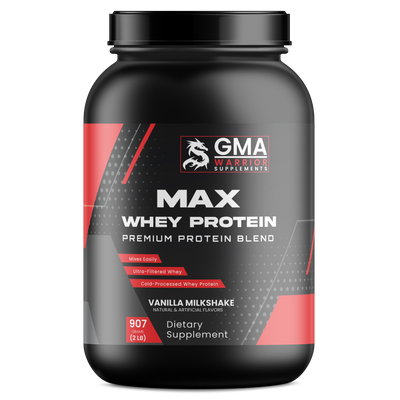
Go whey if you tolerate dairy without issues and want the simplest, most leucine-dense path to a solid dose. It absorbs fast, it mixes thin, and gram for gram it's the efficient option — which is why our Max Whey Protein Vanilla Milkshake is still the most-used tub in the lineup.
Go plant if dairy leaves you bloated or heavy, if you're vegan or vegetarian, or if you've simply never gotten along with whey. A slightly larger scoop of a quality blend puts you on level footing, and the research above says your strength gains won't know the difference.
If you have a diagnosed milk allergy, a kidney condition, or you're pregnant or nursing, talk to your healthcare provider before adding any protein supplement — that's a conversation about your situation, not a label-reading exercise.
What we've watched play out over 50+ years of coaching at Global Martial Arts USA is that the students who recover best aren't the ones who picked the theoretically optimal powder. They're the ones who actually drink it, consistently, on top of real food and real sleep. The best protein is the one still in your bag in six months.

What Matters More Than the Label
Total daily protein beats source. Spreading it across three or four feedings beats stacking it into one. And training hard enough to need it beats all of the above.
Timing is far less urgent than the supplement industry suggests — our breakdown of protein powder for muscle recovery walks through what the anabolic-window research really supports. And if you're weighing whether you need a separate amino acid product on top of your powder, BCAA vs protein powder answers that one directly.
Pick the tub your gut tolerates and your schedule survives. Then go do the work that makes it matter.
Sources & Research
- Reid-McCann, R. J., Brennan, S. F., Ward, N. A., Logan, D., McKinley, M. C., & McEvoy, C. T. "Effect of Plant Versus Animal Protein on Muscle Mass, Strength, Physical Performance, and Sarcopenia: A Systematic Review and Meta-analysis of Randomized Controlled Trials." Nutrition Reviews, 83(7):e1581–e1603, 2025. doi.org/10.1093/nutrit/nuae200
- Lim, C., Janssen, T. A. H., Currier, B. S., et al. "Muscle Protein Synthesis in Response to Plant-Based Protein Isolates With and Without Added Leucine Versus Whey Protein in Young Men and Women." Current Developments in Nutrition, 8(6):103769, 2024. pmc.ncbi.nlm.nih.gov
- Babault, N., Païzis, C., Deley, G., et al. "Pea proteins oral supplementation promotes muscle thickness gains during resistance training: a double-blind, randomized, placebo-controlled clinical trial vs. whey protein." Journal of the International Society of Sports Nutrition, 12:3, 2015. pmc.ncbi.nlm.nih.gov
- Herreman, L., Nommensen, P., Pennings, B., & Laus, M. C. "Comprehensive overview of the quality of plant- and animal-sourced proteins based on the digestible indispensable amino acid score." Food Science & Nutrition, 8(10):5379–5391, 2020. pmc.ncbi.nlm.nih.gov