A men's skincare routine over 40 does not need ten products. It needs four steps, and most men are already doing one of them badly. The face you have at 45 is mostly the sum of two things — how much sun you have taken, and how you shave — and both are still in your hands.
Here is what the evidence supports after 40, in order — plus an honest accounting of which steps GMA sells and which we don't.
What Changes in Men's Skin After 40
Men start with an advantage and lose it quietly. Male skin is thicker, and forearm measurements in the British Journal of Dermatology found skin collagen was lower in women at every age tested — but collagen fell with age in both sexes. Thicker skin buys you time; it does not buy an exemption.
What differs is the exposure. Decades of outdoor work and sport, plus a scalp and ears that never see a hat, show up as coarse texture, deep creases and uneven pigment. The other men-specific variable is the razor: a face scraped five times a week has a barrier that never fully closes.
A sharper reason to pay attention: in a Dutch registry study of 54,645 melanoma patients, men presented with thicker tumors than women — median Breslow thickness 1.00 mm against 0.82 mm — and after multivariable correction men still had a relative excess risk of dying of 1.37 (95% CI 1.31–1.45). The American Academy of Dermatology puts it plainly: men over 50 carry a higher melanoma risk than the general population. Checking your own skin is part of the routine, not an add-on.

The Four Steps in a Men's Skincare Routine Over 40
Ranked by evidence, not by marketing.
1. Sunscreen, every morning
This is the only anti-aging step with a randomized controlled trial behind it. In the Nambour trial, in Annals of Internal Medicine, 903 Australian adults were assigned to daily broad-spectrum sunscreen or discretionary use for four and a half years. The daily group showed no detectable increase in skin aging at all, and aged 24% less than the discretionary group (relative odds 0.76, 95% CI 0.59–0.98). The same trial tested 30 mg of β-carotene and found no overall effect — worth knowing before you buy a supplement for your skin.
The AAD's spec: broad-spectrum, water-resistant, SPF 30 or higher, on every exposed area including scalp, ears, neck and lips, reapplied every two hours or straight after sweating. That last clause matters if you train outdoors.
2. A retinoid at night
A 2025 Bayesian network meta-analysis in Scientific Reports pooled 23 randomized trials and 3,905 participants. Isotretinoin, retinol and tretinoin all significantly improved fine wrinkles; tazarotene ranked highest for coarse wrinkles, glycolic acid for roughness, tretinoin and retinol for hyperpigmentation. On safety, tretinoin had the most favorable profile; tazarotene and glycolic acid carried higher adverse-event risk.
A 2024 systematic review in American Journal of Clinical Dermatology reached the same verdict from the other direction: across 25 studies, comparators beat tretinoin in 7, tied in 13 and lost in 3 — but most were better tolerated. The reason people quit it is irritation, not weak results. Our guides to using retinol without irritation and how often to use retinol cover the ramp and the cadence.
3. Moisturize, on damp skin
Moisturizer traps water in the skin, softening fine lines and taking the edge off the tightness after a shave. The AAD's timing note is the part most men skip: apply it immediately after showering or shaving, while the skin is still damp. This is the step our premium skin care range is built for; choosing a formula is covered in our dermatologist recommended moisturizer guide.
4. Cleanse — but gently
Wash daily and after training. The AAD warns against regular bar soap, often harsh enough to be drying, and against hot water; a mild facial cleanser and lukewarm water is the instruction. Acne-prone: look for "oil free" or "non-comedogenic". Sensitive: "fragrance free" — and be wary of "unscented", which often means a masking fragrance.

Shaving Is the Step Most Men Get Wrong
No other part of a man's routine does mechanical damage on a schedule, and the AAD's guidance runs against how most men were taught to shave: if you get razor bumps, burn or ingrown hairs, drop to a single- or double-blade razor rather than a multi-blade, and do not pull the skin taut. Wet the skin first, use a moisturizing shaving cream, shave with the grain, rinse the blade after every swipe, and change it every five to seven shaves.
Persistent bumps along the jaw and neck are not always "razor burn" — pseudofolliculitis barbae is a distinct condition, more common in men with coarse or curly facial hair, and it has real treatment options. If yours is not settling with technique changes, that is a dermatologist conversation.
Fifty years of running a martial arts school teaches you where skin takes its beating: mat friction, sweat sitting on the face through a class, and the shave the next morning on skin that has not recovered. Train, shower, moisturize while damp, shave on a day the skin can take it.
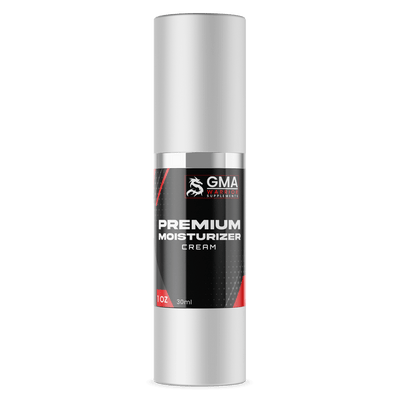
GMA Warrior Premium Moisturizer Cream — a lightweight botanical cream (aloe vera, ginseng, carrot, avocado oil) for step three: the post-shower, post-shave moisturize. Not a sunscreen, not a retinoid, and not sold as either.
Shop Premium Moisturizer Cream →What GMA Sells for This Routine — and What We Don't
Four steps, and we make products for one. You should hear that from us rather than work it out at checkout.
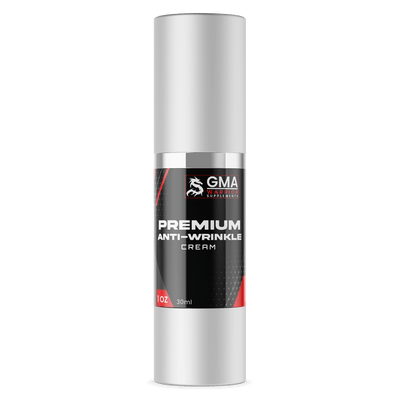
We sell two topicals: the Premium Moisturizer Cream above, and the Premium Anti-Wrinkle Cream, both built on the same botanical base of aloe vera, ginseng and carrot. Neither contains a retinoid, vitamin C or an SPF. GMA makes no cleanser and no sunscreen — so the single most evidence-backed step here is one you will buy somewhere else. Buy it anyway. A 24% reduction in measured skin aging beats anything in our range, and we would rather say so than sell around it.
Our creams are for the moisturize step, done consistently, on damp skin. That is a real step. It is just not the whole routine, and nothing on our shelf is. To understand the actives we don't sell before you shop for them, start with retinol vs vitamin C.

What to Expect, and When
Sunscreen pays nothing back visibly — its return is the damage that doesn't happen. A retinoid is the opposite: worse before better, on a timeline of months. Moisturizer is the only step that gives you something the same day, which is exactly why men over-rate it.
Judge a men's skincare routine over 40 on a year, not a fortnight. And if a spot on your face, scalp or ears is new, itching, bleeding or changing color, stop reading skincare articles and book a dermatologist — for men over 40 that is the highest-value thing on this page. Nothing here is medical advice; anything about your own skin, medication or a specific condition is a conversation for your healthcare provider.
Sources & Research
- Hughes MC, Williams GM, Baker P, Green AC. "Sunscreen and prevention of skin aging: a randomized trial." Annals of Internal Medicine, 2013;158(11):781–790. PMID 23732711
- Lin L, Chen X, Liu C, et al. "Comparative efficacy of topical interventions for facial photoaging: a network meta-analysis." Scientific Reports, 2025;15(1):26889. PMID 40707570
- Siddiqui Z, Zufall A, Nash M, et al. "Comparing Tretinoin to Other Topical Therapies in the Treatment of Skin Photoaging: A Systematic Review." American Journal of Clinical Dermatology, 2024;25(6):873–890. PMID 39348007
- El Sharouni MA, Witkamp AJ, Sigurdsson V, et al. "Sex matters: men with melanoma have a worse prognosis than women." Journal of the European Academy of Dermatology and Venereology, 2019;33(11):2062–2067. PMID 31246315
- Shuster S, Black MM, McVitie E. "The influence of age and sex on skin thickness, skin collagen and density." British Journal of Dermatology, 1975;93(6):639–643. PMID 1220811
- American Academy of Dermatology. "Skin care tips for men." aad.org