Few supplements have been studied as much as fish oil — and few have been as misunderstood. Walk into any pharmacy and you'll see shelves of softgels promising sharper memory, stronger joints, and a healthier heart. The reality of fish oil benefits is more nuanced. The omega-3 fatty acids EPA and DHA do real, measurable work inside the body, but only when you understand which benefits the research actually supports, how much you need to take, and where the marketing gets ahead of the evidence.
This guide cuts through the noise. We'll cover what's actually in a quality fish oil capsule, the four areas where the science is strongest, how to dose it, and the side-effect signals worth paying attention to. We've spent fifty years in martial arts coaching athletes through recovery — fish oil has been a quiet staple of that work, but only because we keep checking the research, not because we love the smell.
What's Actually in Fish Oil — EPA, DHA, and Why It Matters
Fish oil is shorthand for a pair of long-chain omega-3 fatty acids: eicosapentaenoic acid (EPA) and docosahexaenoic acid (DHA). EPA is the inflammation modulator. DHA is the structural one — it's a major building block of brain and retinal cell membranes. Together they're what your body actually uses; the plant-based omega-3 you find in flax or chia (alpha-linolenic acid, or ALA) has to convert into EPA and DHA inside the body, and the conversion rate is poor in humans, often under 5%.
That's why high-quality fish oil supplements list the EPA and DHA content on the label, not just total "fish oil milligrams." A 1,000 mg fish oil capsule might contain only 300 mg of combined EPA and DHA — the rest is filler oil. When you compare products, compare the EPA+DHA totals, not the capsule size.
The fish oil supplements that hold up to lab testing share a few things in common: pelagic (open-ocean) fish sources, third-party purity testing for heavy metals like mercury, and a clear EPA+DHA breakdown per serving. That's the floor — anything below it isn't worth the shelf space.
The Heart Health Case Is the Strongest Benefit
The most consistent evidence for fish oil benefits is cardiovascular. Decades of clinical trials and meta-analyses converge on one well-supported claim: EPA and DHA support healthy blood triglyceride levels. A 2025 systematic review and dose-response meta-analysis published in Food Science & Nutrition found that daily intake of 3 to 4 grams of combined EPA and DHA produced significant reductions in serum triglycerides in adults with elevated baseline levels.
The American Heart Association recommends roughly 1 gram per day of combined EPA and DHA for people with established heart disease, ideally from oily fish, with supplements as a practical alternative when dietary intake falls short. The mechanism isn't mysterious: EPA and DHA modulate lipid metabolism, support endothelial function, and influence inflammatory pathways that drive arterial plaque formation.
This is structure-function science, not a cure. Fish oil supports cardiovascular health. It does not treat or prevent heart disease, and anyone with a diagnosed cardiac condition should be working directly with a healthcare provider before adding or changing supplements. The benefit is real; the framing matters.

Brain Health and Cognitive Function
DHA is one of the most abundant fatty acids in human brain tissue. That's not marketing — that's anatomy. Roughly 30% of the brain's structural lipids are DHA, concentrated in the synaptic membranes where neurons communicate. The practical question has always been whether supplementing with omega-3s actually translates into measurable cognitive benefits in adults.
A 2025 systematic review and dose-response meta-analysis published in Scientific Reports pooled data across 24 randomized controlled trials and found that each 2,000 mg per day of omega-3 supplementation was associated with significant improvements in attention and perceptual speed. A separate large observational study from UT Health San Antonio linked higher blood omega-3 levels to larger hippocampal volume — the brain region central to learning and memory.
What the research does not show is that fish oil reverses Alzheimer's disease or sharpens an already-healthy young brain into a faster one. The cognitive support is most pronounced in adults with low baseline omega-3 intake and in middle-aged or older adults concerned with healthy cognitive aging. If your diet already includes salmon, sardines, or mackerel two or three times a week, the marginal benefit from a supplement may be small. If it doesn't, that gap is exactly what a quality fish oil is built to close.
Inflammation, Joint Comfort, and Training Recovery
EPA is the omega-3 your inflammation pathways pay the most attention to. It's a precursor to the resolvins and protectins — signaling molecules that help the body resolve acute inflammation rather than letting it linger. This is why fish oil shows up in research on rheumatoid arthritis (where it may help support joint comfort and reduce morning stiffness, often modestly) and in the literature on exercise recovery.
A 2020 randomized trial published in Nutrients examined varying fish oil doses on muscle soreness and recovery following eccentric exercise — the kind of muscle damage you accumulate in any serious training program. The higher-dose groups (around 6 grams per day for short courses) saw measurable reductions in delayed-onset muscle soreness and inflammatory markers compared to placebo. That dose is higher than daily-wellness use; it's a recovery protocol, not a baseline.
For athletes, training-heavy adults, and anyone using their body hard — which describes most of the people we coach at our martial arts school in Gallatin, TN — the joint and recovery angle is where the supplement earns its keep alongside cardiovascular support. It's not a painkiller. It's structural support for the tissues you're asking to bounce back, week after week.
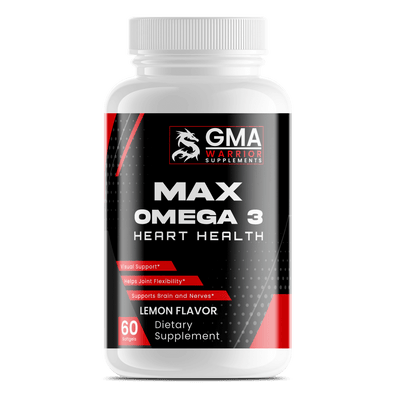
GMA Warrior Max Omega 3 — pelagic, third-party tested fish oil with a high EPA + DHA ratio per serving. Made in a GMP-certified, FDA-registered facility, purified of the heavy metals that contaminate cheap fish oil. The same formula our coaches use to support cardiovascular and joint health through decades of training.
Shop Max Omega 3 →How Much Fish Oil Should You Take?
Dosing depends on what you're after. The NIH Office of Dietary Supplements and FDA guidelines together draw a reasonable map. For general health support, most adult intake recommendations land between 250 and 500 mg of combined EPA and DHA per day — an amount you can hit from oily fish twice a week, or from a single softgel of a concentrated supplement.
For people specifically focused on cardiovascular support, the American Heart Association guideline of about 1 gram of EPA+DHA daily is the most-cited target. Triglyceride-management doses go higher — 3 to 4 grams per day — but those should be coordinated with a healthcare provider because they cross into territory where drug interactions and bleeding risk become relevant considerations.
The FDA recommends no more than 3 grams per day of combined EPA and DHA total, with up to 2 grams of that coming from supplements. That ceiling exists for a reason: high-dose fish oil affects platelet function, and there's emerging research, including a 2025 meta-analysis covering more than 80,000 participants, suggesting dose-related increases in the risk of atrial fibrillation at the higher supplement ranges. The takeaway isn't "fish oil is dangerous" — the takeaway is "more isn't automatically better." A well-formulated daily dose serves most people better than chasing the highest gram count on the label.

Timing, Storage, and Getting the Most From Your Supplement
Fish oil is fat-soluble, which means it absorbs better when taken with a meal that contains some dietary fat. Splitting your daily dose across two meals tends to reduce the fishy aftertaste that some people get with a single large dose. If you're someone who consistently experiences reflux or fishy burping, refrigerating your softgels can blunt that effect, and some people prefer enteric-coated capsules that dissolve in the small intestine rather than the stomach.
Quality matters more than timing. Rancid fish oil — oxidized from heat, light, or age — loses much of its biological activity and can actually contribute to oxidative stress rather than reduce it. Look for products with a clear manufacturing date, opaque packaging, and (this is non-negotiable) third-party purity testing for heavy metals and PCBs. If you can't find that information on a brand's website, that's the brand telling you something.
Fish oil pairs well with the other foundational supplements in a daily stack. Many of our athletes layer it alongside magnesium for sleep and recovery — different mechanism, complementary effect on the systems training puts under load.
Side Effects and Who Should Be Cautious
For most healthy adults, fish oil is well tolerated at moderate doses. The most common side effects are the ones you'd expect from any fat: mild digestive upset, occasional reflux, and a fishy aftertaste. These are generally dose-dependent and resolve when you adjust timing or split the dose.
The less-common but more important considerations involve interactions. Fish oil mildly affects platelet aggregation, which means anyone taking anticoagulant or antiplatelet medication — warfarin, clopidogrel, aspirin therapy — should talk to their prescribing doctor before adding a fish oil supplement, especially at doses above 1 gram per day. The same conversation applies to anyone scheduled for surgery within the next two weeks, as a precaution against increased bleeding.
Pregnancy is its own category. DHA supports fetal brain and eye development, and pregnant or nursing people should discuss specific dosing with their healthcare provider rather than self-prescribing. Children under 18 should also follow professional guidance rather than adult product labels. None of this is reason to avoid fish oil — it's reason to use it the way you'd use anything that has a real biological effect: thoughtfully, with the right inputs.

The Honest Summary on Fish Oil Benefits
The most rigorously supported fish oil benefits are cardiovascular (triglyceride support, endothelial function), structural support for brain and joint tissues, and modulation of inflammatory pathways relevant to recovery. The marketing claims that get ahead of the science — "boosts memory overnight," "cures arthritis," "burns fat" — are not what the research shows, and a brand that leans on those claims is a brand to skip.
What a quality fish oil does deliver is steady, foundational support for the systems that have to keep working under load: a healthy heart, a clear-thinking brain, joints that recover from yesterday's training so they're ready for tomorrow's. That's what we built Max Omega 3 for, and what's earned it a spot in the general health stack we recommend to every adult who trains seriously — or just wants to feel good doing the work life requires.
Sources & Research
- National Institutes of Health, Office of Dietary Supplements. "Omega-3 Fatty Acids — Health Professional Fact Sheet." ods.od.nih.gov
- Zhang, Y. et al. "Effects of Omega-3 Fatty Acids Intake on Lipid Metabolism and Plaque Volume in Patients With Coronary Heart Disease: A Systematic Review and Dose-Response Meta-Analysis of Randomized Clinical Trials." Food Science & Nutrition, 2025. onlinelibrary.wiley.com
- "A Systematic Review and Dose-Response Meta-Analysis of Omega-3 Supplementation on Cognitive Function." Scientific Reports, 2025. nature.com
- VanDusseldorp, T.A. et al. "Impact of Varying Dosages of Fish Oil on Recovery and Soreness Following Eccentric Exercise." Nutrients, 2020;12(8):2246. pmc.ncbi.nlm.nih.gov