Hard training breaks muscle down. Recovery is where it gets rebuilt stronger — and protein is the raw material that rebuild runs on. That is why protein powder for muscle recovery has become a staple in gym bags everywhere, from powerlifters to the fighters who train on our mats. But the marketing around recovery shakes has gotten far ahead of the science. A powder is not magic; it is a convenient way to hit a protein target your body is already asking for.
This guide cuts through the noise: how protein actually drives recovery, how much you need after a session, whether the “anabolic window” is real, and how whey and plant proteins stack up. We have spent 50+ years coaching athletes through hard training blocks at Global Martial Arts USA, and the principles below are the ones that hold up under both the research and the reality of training day after day.
How Protein Powder for Muscle Recovery Works
Every demanding workout — a heavy lift, a hard round of sparring, a long grappling session — creates microscopic damage in your muscle fibers. Your body responds by repairing those fibers and, over time, building them back thicker and more resilient. That repair process is driven by muscle protein synthesis (MPS), the biological assembly line that stitches amino acids into new muscle tissue.
Protein supplies those amino acids. When you eat enough high-quality protein after training, you give that assembly line the materials it needs to work at full speed. When you come up short, repair slows and you carry more fatigue into your next session. Research shows that a single bout of resistance exercise keeps muscle sensitized to protein for at least 24 hours, with the strongest response in the first several hours afterward.
Protein powder did not invent this process — whole foods like eggs, chicken, and Greek yogurt feed it just as well. What a powder offers is convenience and precision: a fast, measurable dose of protein when you are walking off the mat and a full meal is still an hour or two away. That is the honest case for it, and it is a good one.

How Much Protein You Need After Training
The biggest mistake people make is obsessing over the post-workout shake while ignoring their total daily intake. Daily protein is what drives recovery over weeks and months. The International Society of Sports Nutrition (ISSN) position stand recommends most active people consume 1.4 to 2.0 grams of protein per kilogram of body weight per day to support lean mass and recovery — and the upper end of that range suits athletes in heavy training blocks.
For the dose right around training, the research points to roughly 0.25 to 0.40 grams per kilogram of body weight per serving. In practical terms, that is about 20 to 35 grams of protein for most adults — which is exactly where a single scoop of a quality whey isolate lands. Going much higher in one sitting does not stimulate extra muscle repair; the surplus is simply used for energy or other functions.
Just as important as the size of each dose is spreading protein across the day. Distributing your intake into three to five servings every three to four hours keeps muscle protein synthesis topped up rather than spiking once and crashing. If you want a full breakdown of daily targets by body weight and training goal, see our companion guide on how much protein you really need.
Does Timing Matter? The Truth About the Anabolic Window
For years, lifters were told they had a 30- to 60-minute “anabolic window” after training to slam a shake or lose their gains. The evidence has not been kind to that idea. A widely cited meta-analysis by Schoenfeld and colleagues found that when total daily protein is equal, the precise timing of intake around a workout has little independent effect on strength or muscle growth. The apparent benefits in early timing studies traced back to the groups simply eating more protein overall.
More recent systematic reviews reach the same conclusion: if a peri-workout window exists at all, it is far wider than one hour — likely several hours on either side of training, depending on when and what you last ate. In other words, you do not need to sprint to your shaker before the sweat dries.
So where does that leave the recovery shake? Still useful, just for practical reasons rather than a ticking clock. If you trained fasted or your last meal was many hours ago, protein soon after training is smart. And if a shake is simply the easiest way to hit your daily target, the post-workout moment is a convenient, habit-forming time to take it. Convenience — not panic — is the real value of timing.
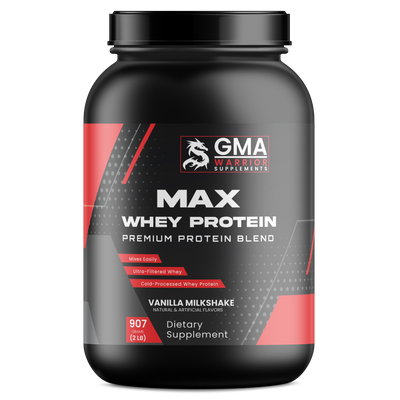
GMA Warrior Whey Protein Isolate Vanilla — a micro-filtered isolate that delivers a lean, fast-absorbing 20–35 g recovery dose with the leucine your muscles need to rebuild after hard training.
Shop Whey Protein Isolate →Whey vs Plant Protein for Recovery
Whey protein has long been the recovery gold standard, and for good reason: it digests quickly and is rich in leucine, the amino acid that flips the switch on muscle protein synthesis. A whey isolate is filtered to strip out most of the fat and lactose, leaving a concentrated, fast-absorbing protein source — which is why it works so well as a post-training option.
But plant protein has closed the gap. Recent research shows that single-source plant proteins can fall short on their own, yet well-formulated plant blends — think pea combined with rice — can stimulate muscle repair on par with whey. The key is dose and leucine content: studies suggest plant servings of at least 30 grams, delivering roughly 2.5 to 3 grams of leucine, produce a recovery response comparable to whey.
The practical takeaway: if you tolerate dairy, a whey isolate is an efficient, proven choice for recovery. If you avoid animal products, a properly dosed plant blend will get you there too — just size the serving up slightly and check that it lists its leucine or amino acid profile. Both can anchor a solid recovery routine.

What Protein Can — and Can't — Do for Soreness
Plenty of people reach for a recovery shake hoping to erase next-day soreness. Here the claims need a reality check. Adequate protein supports the repair of training-induced muscle damage and may help reduce the severity of delayed-onset muscle soreness (DOMS) by supplying the amino acids your body uses to rebuild. Some research even points to added benefit when protein is paired with omega-3s.
But protein is not a painkiller, and no shake will undo the cost of consistently training far beyond what you have recovered from. Soreness is influenced by sleep, hydration, total training load, and how new or intense the workout was — protein is one lever among several. If you are chronically sore, beat up, or noticing pain that feels like more than ordinary training fatigue, that is a signal to back off and, when warranted, consult a healthcare provider rather than chase it with supplements.
Used realistically, protein powder supports faster turnaround between sessions so you can train hard again sooner. That is a meaningful edge over a season — just not the overnight miracle the labels imply.
How to Build Protein Into Your Recovery Routine
Here is how we coach it. First, set your daily target — somewhere in the 1.4 to 2.0 g/kg range based on your size and how hard you are training. Then work backward, spreading that total across the day in 20- to 40-gram servings. A recovery shake is the easiest one to lock in: it travels well and goes down even when a hard session has killed your appetite for solid food.
The athletes coming off the mats in our martial arts classes in Gallatin, TN rarely feel like eating a full meal right after training — but they can drink one. That is the practical role a quality protein powder plays: it bridges the gap until the next real meal and makes hitting your daily number realistic instead of aspirational.
Recovery is a system, not a single supplement. Protein anchors it, but it works alongside the rest of your nutrition, your sleep, and smart programming. Explore the full lineup in our premium sports nutrition supplements collection, and if creatine is part of your stack, our guide on the best time to take creatine pairs naturally with a recovery-focused protein routine.

Sources & Research
- Jäger, R., Kerksick, C. M., Campbell, B. I., et al. “International Society of Sports Nutrition Position Stand: Protein and Exercise.” Journal of the International Society of Sports Nutrition, 2017. jissn.biomedcentral.com
- Schoenfeld, B. J., Aragon, A. A., & Krieger, J. W. “The Effect of Protein Timing on Muscle Strength and Hypertrophy: A Meta-Analysis.” Journal of the International Society of Sports Nutrition, 2013. ncbi.nlm.nih.gov
- “Does Protein Ingestion Timing Affect Exercise-Induced Adaptations? A Systematic Review with Meta-Analysis.” Nutrients, 2025. ncbi.nlm.nih.gov
- “Effect of Plant-Based Proteins on Recovery from Resistance Exercise-Induced Muscle Damage in Healthy Young Adults: A Systematic Review.” Nutrients, 2025. mdpi.com