If your mind races at night, your shoulders live up around your ears, and you feel wired-but-tired more often than calm, you are not alone — and you have probably wondered whether a magnesium supplement for anxiety is worth trying. It is one of the most searched-for natural options for stress, and unlike a lot of wellness trends, it actually has real research behind it. Magnesium is a mineral your nervous system depends on every single day, and many people simply do not get enough from food.
Here is the honest version, the same way we coach it at GMA: magnesium is not a cure for an anxiety disorder, and it will not erase real stress from your life. But for mild, everyday anxiety and tension — especially if you are running low on the mineral to begin with — it is one of the safest, best-supported places to start. Below we break down what the science says, the best form and dose, how it fits with other calming supplements, and when to talk to your doctor instead.
Can a Magnesium Supplement for Anxiety Really Help?
The short answer: for many people, yes — modestly. A widely cited systematic review in the journal Nutrients (Boyle and colleagues, 2017) looked at the existing trials and concluded that magnesium appears to have a beneficial effect on subjective anxiety, particularly in people who are "anxiety-vulnerable" — those dealing with mild anxiety, premenstrual symptoms, or higher stress loads. A more recent 2024 systematic review on supplemental magnesium for self-reported anxiety and sleep reached a similar place: most high-quality trials showed at least modest improvements, with the strongest effects in people who started out low in magnesium.
Notice the pattern. Magnesium tends to help most when there is a gap to fill. If your levels are already healthy, the calming effect is smaller. That is actually good news, because it means a magnesium supplement is less about "drugging" your stress response and more about restoring something your nervous system needs to run smoothly. It also means the results are realistic — supportive, not dramatic — which is exactly how we talk about supplements with our students.
It is worth being clear-eyed about the limits of the evidence, too. Many of the studies are small, they use different forms and doses, and "anxiety" is measured by self-report questionnaires rather than hard biology. That is why researchers describe the effect as promising rather than proven. What you should take from it is reasonable confidence, not hype: a magnesium supplement is a low-risk, decently-supported tool for everyday tension — and the people most likely to notice a difference are the ones who were short on the mineral in the first place.

How Magnesium Calms the Nervous System
Magnesium is involved in more than 300 enzyme reactions in the body, but a few of them matter directly for how calm — or how on-edge — you feel. It helps regulate the balance between your "go" and "slow" signals in the brain. Specifically, magnesium supports healthy activity at GABA receptors (GABA is your main calming neurotransmitter) while helping keep glutamate, an excitatory signal, in check. When that balance tips too far toward excitation, you get the keyed-up, can't-switch-off feeling.
It also plays a role in the stress-hormone system. Magnesium helps moderate the HPA axis — the loop that releases cortisol when you are under pressure. Low magnesium and high stress can feed each other in a frustrating cycle: stress depletes magnesium, and low magnesium can leave your stress response more reactive. Topping up the mineral helps support a steadier baseline. None of this "treats" anxiety in a clinical sense, but it explains why so many people describe a magnesium supplement as taking the edge off rather than knocking them out.
The Best Form and Dose of Magnesium for Anxiety
Not all magnesium is created equal, and the form matters more than the milligram number on the front of the bottle. For calm and sleep, magnesium glycinate is the form most often recommended — it is highly absorbable and gentle on the stomach, which matters because the cheaper forms (like magnesium oxide) are poorly absorbed and far more likely to send you running to the bathroom. Magnesium citrate is a reasonable second choice; magnesium L-threonate is studied more for cognition than calm.
On dosing, the research that showed benefits generally used a few hundred milligrams of elemental magnesium per day — many trials landed in the 200–350 mg range, taken consistently over several weeks rather than as a one-off. Consistency is the whole game here; magnesium is a "fill the tank slowly" supplement, not an on-demand calming pill. The safe upper limit for supplemental magnesium in adults is 350 mg of elemental magnesium per day according to the NIH, so staying at or below that — and getting the rest from food — is a sensible target. Food sources are genuinely powerful too: leafy greens, pumpkin seeds, almonds, black beans, and dark chocolate are all magnesium-rich.

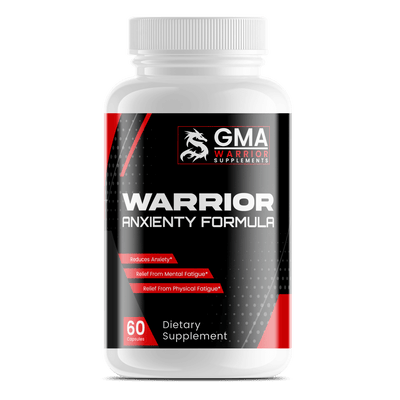
GMA Warrior Anxiety Formula — a calm-support blend that pairs magnesium with research-backed botanicals like ashwagandha, L-theanine, chamomile, and lemon balm, all dosed to support relaxation and a steadier stress response.*
Shop Anxiety Formula →Beyond Magnesium: Other Natural Supplements for Stress
Magnesium is the foundation, but it is not the only natural option with real evidence behind it. If you are building a calm-support stack, two ingredients stand out alongside it:
Ashwagandha. This adaptogenic herb has the strongest research of the bunch. A 2022 systematic review and meta-analysis in Phytotherapy Research pooled twelve randomized controlled trials and found ashwagandha significantly reduced both anxiety and stress scores compared with placebo, alongside lower cortisol. It is best known for supporting the body's resilience to stress over a few weeks of consistent use.
L-theanine. An amino acid from tea leaves, L-theanine is studied for promoting a relaxed-but-alert state without sedation — useful when you want to feel calmer without feeling foggy. Reviews suggest doses around 200 mg can support a reduction in stress and tension under pressure.
This is exactly why our Warrior Anxiety Formula combines magnesium with ashwagandha, L-theanine, and calming botanicals rather than relying on a single ingredient — the nervous system responds to a layered approach. If sleep is part of your stress picture, magnesium does double duty: see our complete guide to magnesium glycinate for sleep for how the same mineral supports a calmer wind-down. You can explore the full lineup in our nootropic supplements collection.
Habits That Make Any Anxiety Supplement Work Better
No capsule outworks your daily habits — a truth we have watched play out over 50+ years of coaching. A magnesium supplement gives your nervous system better raw materials, but the habits around it decide how much you actually feel. Three move the needle most:
Move your body. Hard, focused physical training is one of the most reliable stress regulators there is. The athletes and students we coach consistently report that the mat is where the mental noise goes quiet — structured movement burns off stress hormones and gives an anxious mind somewhere to go. Lower-intensity, mind-body practice helps too; many of our members use tai chi for stress relief to pair breath with slow, deliberate movement.
Protect your sleep. Poor sleep and anxiety amplify each other. Magnesium can support a calmer wind-down, but pairing it with a consistent bedtime, less late-night screen time, and a dark room compounds the benefit. Breathe on purpose. Slow nasal breathing — longer exhales than inhales — flips your nervous system toward its calm "rest and digest" mode within minutes, and it costs nothing.

When to Talk to a Healthcare Provider
A magnesium supplement is safe for most healthy adults at sensible doses, but it is not the right move for everyone, and it is not a substitute for care. Talk to your healthcare provider before starting if you take prescription medications (magnesium can interact with certain antibiotics, blood pressure drugs, and others), if you have reduced kidney function (your kidneys clear excess magnesium, so impaired function changes the safety math), or if you are pregnant or nursing. If you are dealing with persistent, severe, or worsening anxiety — panic attacks, anxiety that interferes with work or relationships, or any thoughts of self-harm — please reach out to a qualified professional. That is not a supplement problem to solve alone, and getting real support is a sign of strength, not weakness. Used the right way, magnesium is a smart, low-risk part of a bigger picture — never the whole plan.
Sources & Research
- Boyle NB, Lawton C, Dye L. "The Effects of Magnesium Supplementation on Subjective Anxiety and Stress—A Systematic Review." Nutrients, 2017;9(5):429. ncbi.nlm.nih.gov
- Rawji A, et al. "Examining the Effects of Supplemental Magnesium on Self-Reported Anxiety and Sleep Quality: A Systematic Review." 2024. ncbi.nlm.nih.gov
- National Institutes of Health, Office of Dietary Supplements. "Magnesium — Health Professional Fact Sheet." ods.od.nih.gov
- Akhgarjand C, et al. "Does Ashwagandha supplementation have a beneficial effect on the management of anxiety and stress? A systematic review and meta-analysis of randomized controlled trials." Phytotherapy Research, 2022;36(11):4115–4124. onlinelibrary.wiley.com