The magnesium shelf has turned into a wall of options — oxide, malate, threonate, taurate. But two forms account for most of what people buy, and the question we get in the gym is always the same: magnesium glycinate vs citrate, which one should you take?
The honest answer is that the internet has this one backwards. The popular story says glycinate is the premium, better-absorbed form and citrate is the cheap one that sends you to the bathroom. The research says something quieter and more useful: both are well-absorbed organic forms, no one has ever tested them head-to-head, and the thing that should decide it isn't absorption at all.
Magnesium Glycinate vs Citrate: What Actually Separates Them
Magnesium can't be sold as a standalone pill — it has to be bound to a carrier molecule. In citrate, that carrier is citric acid. In glycinate (also labeled bisglycinate), it's two molecules of the amino acid glycine.
The magnesium itself is identical. What changes is the passenger riding along with it. Citric acid pulls water into your intestine; glycine is a calming amino acid. That's the entire practical difference — and it has nothing to do with which one is "stronger."

What the Absorption Research Actually Found
The one randomized trial that put these categories side by side is Walker and colleagues in Magnesium Research, 2003. Forty-six healthy adults took 300 mg of elemental magnesium daily for 60 days in a double-blind, placebo-controlled design, comparing an amino-acid chelate, citrate, and oxide.
Both organic forms beat magnesium oxide on 24-hour urinary magnesium excretion (P = 0.033). But the headline result cuts against the marketing: magnesium citrate produced the greatest mean serum magnesium concentration of any treatment tested, after both a single dose and 60 days of daily use — including against the amino-acid chelate.
A 2021 systematic review in Nutrition screened 433 studies and included 14, concluding that "inorganic formulations appear to be less bioavailable than organic ones, and the percentage of absorption is dose dependent." That last clause matters: the bigger the single dose, the smaller the fraction you absorb. Splitting a large dose beats swallowing it at once.
The NIH lists citrate among the forms absorbed more completely than oxide and sulfate. It does not single out glycinate as superior to citrate — because no published trial has directly compared them. When you see "three times more absorbable" on a glycinate label, that number isn't coming from a comparison with citrate. It's coming from a comparison with oxide, the cheapest form on the shelf.
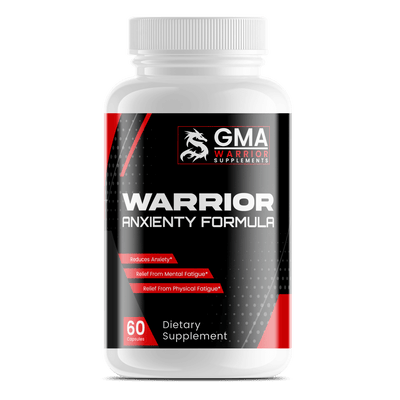
GMA Anxiety Formula — straight talk: we don't make a standalone magnesium supplement in either form. This is our evening relaxation blend, and magnesium sits in it alongside chamomile, lemon balm, valerian, L-theanine and ashwagandha. Our label lists magnesium without naming the form, so check the supplement facts panel before you assume it's glycinate.
Shop GMA Anxiety Formula →Citrate's Real Job Is Your Digestion
Citrate's reputation as "the laxative one" is earned, and it's not a flaw — it's a feature you either want or you don't. Citric acid is osmotically active: it draws water into the bowel, softening stool and encouraging movement. That's exactly why a higher-dose liquid version of this same compound sits in the pharmacy aisle as a saline laxative.
At ordinary supplement doses the effect is usually mild, and it scales with how much you take. If you're already regular, that's a nuisance. If you're not, it's the reason to pick citrate — the mineral and the digestive help from one capsule.
One caution worth stating plainly: leaning on any osmotic laxative as a daily habit isn't a plan. If constipation is persistent rather than occasional, that's a conversation with your healthcare provider.
Glycinate's Real Job Is Bedtime
Glycinate's case rests on its carrier. Glycine is an inhibitory amino acid: the mineral plus a mild calming effect, with no gut stimulation before bed.
The best test of that idea is a 2025 randomized, placebo-controlled trial in Nature and Science of Sleep. Researchers gave 155 adults reporting poor sleep either placebo or 250 mg of elemental magnesium as bisglycinate — delivering 1,523 mg of glycine — before bed for 28 days.
Insomnia Severity Index scores fell 3.9 points in the magnesium group versus 2.3 on placebo (p = 0.049). That's a real result, and we'll report its size honestly: Cohen's d was 0.20 — a small effect. Nineteen percent of the magnesium group hit a clinically meaningful improvement against 11 percent on placebo, and no secondary measure — daytime sleepiness, fatigue, stress, mood — separated from placebo at all.
The most useful finding sat in an exploratory analysis: the lower a participant's baseline dietary magnesium, the more their sleep scores improved (rho = −0.25, p = 0.036). This is a gap-filler, not a sedative — it works best in people who were short to begin with. Our full guide to magnesium glycinate for sleep goes deeper on dosing, and our review of natural sleep supplements puts it against melatonin and valerian.

How to Choose, and How Much to Take
Strip away the marketing and the decision is simple:
- Choose citrate if you want the mineral and you'd welcome help staying regular, or you're taking it earlier in the day.
- Choose glycinate if you're taking it at night, you have a sensitive stomach, or your digestion is already fine and you don't want it disturbed.
On dose: the RDA is 400–420 mg daily for adult men and 310–320 mg for adult women, and that figure includes food. Roughly 30–40% of the magnesium you eat is absorbed, and 48% of Americans take in less than the estimated average requirement — which is why this mineral comes up so often.
The number to respect is the upper limit of 350 mg per day from supplements specifically — it applies to what's in the capsule, not what's on your plate. Read the elemental magnesium figure on the back panel, not the compound weight on the front: "1,000 mg magnesium bisglycinate" is not 1,000 mg of magnesium, and that gap is where most confusion lives.
A few interactions are worth knowing. Separate magnesium from bisphosphonates by at least two hours, and from certain antibiotics by two hours before or four to six hours after. Loop and thiazide diuretics increase magnesium losses, and long-term proton pump inhibitor use — typically beyond a year — can lower magnesium levels. Because magnesium is cleared by the kidneys, anyone with reduced kidney function should talk to a doctor before supplementing at all. Same goes if you're pregnant or nursing, under 18, or taking prescription medication.

One last note from fifty years of running a martial arts school. The adults who train in our evening classes four or five nights a week sweat hard and eat on a compressed schedule — exactly the profile where a magnesium shortfall shows up as twitchy legs and shallow sleep. If that's you, magnesium glycinate vs citrate matters far less than closing the gap: start with pumpkin seeds, leafy greens, nuts and legumes, then supplement what's missing. For a broader evening stack, see our Nootropics collection; Max Neuro Brain Focus Plus carries magnesium on the daytime side. For the stress angle, see our write-up on magnesium for anxiety and our fighter's guide to nootropics.
Sources & Research
- Walker AF, Marakis G, Christie S, Byng M. "Mg citrate found more bioavailable than other Mg preparations in a randomised, double-blind study." Magnesium Research, 2003;16(3):183–191. PMID 14596323
- Pardo MR, Garicano Vilar E, San Mauro Martín I, Camina Martín MA. "Bioavailability of magnesium food supplements: A systematic review." Nutrition, 2021;89:111294. PMID 34111673
- Schuster J, Cycelskij I, Lopresti A, Hahn A. "Magnesium Bisglycinate Supplementation in Healthy Adults Reporting Poor Sleep: A Randomized, Placebo-Controlled Trial." Nature and Science of Sleep, 2025;17:2027–2040. PMID 40918053
- National Institutes of Health, Office of Dietary Supplements. "Magnesium — Fact Sheet for Health Professionals." ods.od.nih.gov